Advertisements
Advertisements
प्रश्न
What is the procedure advised for the correction of extreme renal failure? Give a brief account of it.
Advertisements
उत्तर
Kidney transplantation is the ultimate method in the correction of acute renal failures (kidney failure). A functioning kidney is used in transplantation from a donor, preferably a close relative, to minimise its chances of rejection by the immune system of the host. Modem clinical procedures have increased the success rate of such a complicated technique.
APPEARS IN
संबंधित प्रश्न
Write True (T) or False (F) for the following statement. Rewrite the false statement in the correct form.
Removal of solid undigested food is excretion
What are the two ways by which a person can get relief in case of kidney failure?
How are kidney stones formed?
Answer the following question.
John has two options as a treatment for his renal problem: Dialysis or kidney transplants. Which option should he choose? Why?
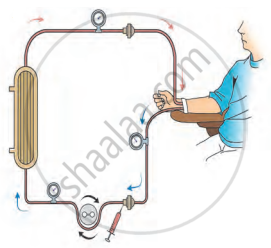
Complete the diagram/chart with correct labels/ information. Write the conceptual details regarding it.
Ketone bodies are found in the urine of people suffering from ______.
In acute renal failure the urine output decreases. This condition is called ____________.
One of the factors which may help to differentiate chronic kidney disease from acute kidney injury is ______
Excretion of uric acid includes the following features EXCEPT ______
Which of the following is CORRECT with reference to haemodialysis?
Haemodialysis is done in the condition when the person is suffering from ______.
Ultimate correction for renal failure is:
The condition of accumulation of urea in the blood is termed as ______.
Explain, why a haemodialysing unit called artificial kidney?
Which of the following conditions does not lead to acute renal failure?
The accumulation of urea in the blood due to malfunctioning of kidneys is referred to as ______.
Renal calculi is ______.
Which statement is correct regarding the haemodialysis procedure?
Oligouria condition in children is when, the urine output is less than ______.
