Advertisements
Advertisements
प्रश्न
What is the effect of aldosterone on kidneys and where is it produced?
Advertisements
उत्तर
Aldosterone is produced by the Adrenal cortex. It increases the reabsorption of sodium and water by distal convoluted tubule and increased secretion of potassium. Hence, it maintains blood volume, blood pressure and urine output.
संबंधित प्रश्न
What are the symptoms of a urinary tract infection?
Answer the following question.
Doctors say Mr. Shaikh is suffering from urolithiasis. How it could be explained in simple words?
Answer the following question.
John has two options as a treatment for his renal problem: Dialysis or kidney transplants. Which option should he choose? Why?
Complete the diagram/chart with correct labels/ information. Write the conceptual details regarding it.
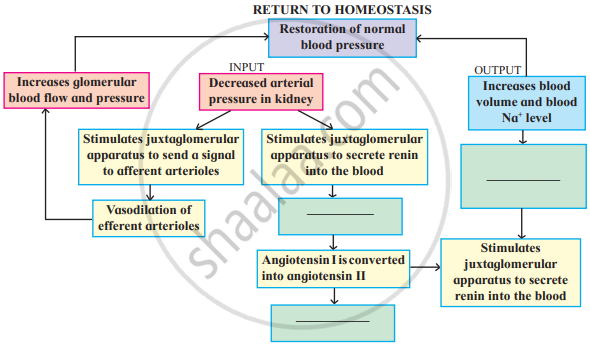
Identify the following structures and explain their significance in renal physiology?
- Juxtaglomerular apparatus
- Podocytes
- Sphincters in the bladder
One of the factors which may help to differentiate chronic kidney disease from acute kidney injury is ______
Bright's disease is characterized by the following symptoms EXCEPT ______
Excretion of uric acid includes the following features EXCEPT ______
Ultimate correction for renal failure is:
The condition of accumulation of urea in the blood is termed as ______.
Match the abnormal conditions given in Column A with their explanations given in Column B and Choose the correct option
| Column A | Column B |
| A. Glycosuria | i. Accumulation of uric acid in joints |
| B. Renal calculi | ii. Inflammation in glomeruli |
| C. Glomerular nephritis | iii. Mass of crystallised salts within the kidney |
| D. Gout | iv. Presence of glucose in urine |
Explain, why a haemodialysing unit called artificial kidney?
Which of the following conditions does not lead to acute renal failure?
Renal calculi is ______.
Presence of which of the following conditions in urine are indicative of diabetes mellitus?
Which one of the following is CORRECT regarding struvite stones in kidney?
I. These are formed in response to bacterial infection.
II. It is a genetic disorder.
III. These grow quickly and become quite large.
IV. Occurs in people who consume a high-protein diet.
V. Affected people excrete too much of certain amino acid.
