Advertisements
Advertisements
प्रश्न
What is Recognition sequence? Explain in brief.
Advertisements
उत्तर
- The sequences recognized by restriction enzymes are 4 to 8 nucleotides long and characterized by a particular type of internal symmetry is known as recognition sequence.
- When the sequence is read in opposite direction (3’ to 5’ or 5’ to 3’) it is identical/ same. For e.g. consider the particular sequence recognized by the enzyme EcoRI. 3’ -______ CTTAAG______ 5’ 5’______ GAATTC ______ 3’
- Restriction enzymes either cut straight across the DNA in the region of palindrome to give blunt ends or cuts producing short, single stranded projections at each end of DNA to produce, cohesive or sticky ends or staggered ends.
संबंधित प्रश्न
Name the genes responsible for making Bt cotton plants resistant to bollworm attack. How do such plants attain resistance against bollworm attacks? Explain.
Describe two vectors less methods of gene transfer used in rDNA technology.
ECoRI is obtained from ______.
Vectors are ____________ molecules that carry a foreign gene and replicate inside the host cell.
Match the List I with List II and List ill. Select the correct option.
| List I | List II | List ill | |||
| i. | Hind III | a. | Agarose ge | 1. | Six base pairs |
| ii. | pBR322 | b. | Agrobacterium | 2. | Selectable marke |
| iii. | T-DNA | c. | Ampicillin | 3. | Elution |
| iv. | DNA | d. | Recognition sequenc | 4. | Transgenic plant |
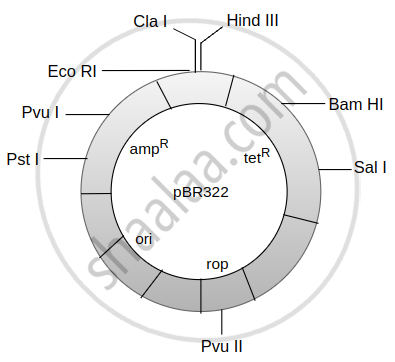
The given figure is the diagrammatic representation of the E. coli vector pBR322. Which one of the given options correctly indentites its certain component(s)?
Which of the following statements are true about cloning vectors?
- Vectors are DNA molecules that carry a foreign DNA segment.
- The replicated DNA is introduced into the host cell.
- It possesses the origin of replication (Ori).
- Vectors may be plasmid, bacteriophage, Yeast artificial chromosomes (YACs), etc.
- Vectors do not require a selectable marker to identify and eliminate non-transformants.
Choose the correct answer from the options given below.
Plasmid is ______.
Give a reason for the following:
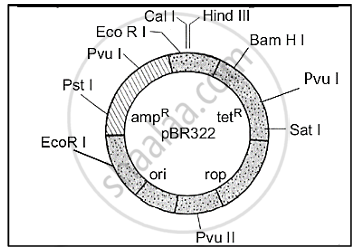
The diagram given below represents vector pBr322 which was modified by a research scholar Dr. Rayon, but the vector was rejected by his guide.
What is the relationship between alien DNA and the origin of replication in the concept of cloning?
