Advertisements
Advertisements
प्रश्न
What all instructions are given by the adults regarding noise?
Advertisements
उत्तर
The adults tell the children not to make much noise, neither while talking nor while eating or walking.
संबंधित प्रश्न
Answer of these question in a short paragraph (30–40 words).
Name the various places and causes for which Evelyn performs.
Listen to the poem.
Oh, I wish I'd looked after me teeth,
And spotted the perils beneath.
All the toffees I chewed,
And the sweet sticky food,
Oh, I wish I'd looked after me teeth.
I wish I'd been that much more willin'
When I had more tooth there than fillin'
To pass up gobstoppers.
From respect to me choppers,
And to buy something else with me shillin'.
When I think of the lollies I licked,
And the liquorice all sorts I picked,
Sherbet dabs, big and little,
All that hard peanut brittle,
My conscience gets horribly pricked.
My mother, she told me no end.
'If you got a tooth, you got a friend.'
I was young then, and careless,
My toothbrush was hairless,
I never had much time to spend.
Oh, I showed them the toothpaste all right,
I flashed it about late at night,
But up-and-down brushin'
And pokin' and fussin'
Didn't seem worth time-I could bite!
If I'd known, I was paving the way
To cavities, caps and decay,
The murder of fillin's
Injections and drillin's,
I'd have thrown all me sherbet away.
So I lay in the old dentist's chair,
And I gaze up his nose in despair,
And his drill it do whine,
In these molars of mine.
"Two amalgum," he'll say, "for in there."
How I laughed at my mother's false teeth,
As they foamed in the waters beneath.
But now comes the reckonin'
It's me they are beckonin'
Oh, I wish I'd looked after me teeth.
About the Poet
Pam Ayres (1947- ) is a contemporary writer, a great entertainer who writes and performs
comic verse. She started writing poems and verses as a hobby and has appeared in every
major TV show in the U.K. She has published six books of poems, and cut seven record
albums including a collection of 50 best known poems.
Understanding determiners.
Determiners are words that are used in front of nouns to indicate whether you are
referring to something specific or something of a particular type.
Singular nouns always need a determiner. In plural nouns, the determiner is
optional. Determiners may or may not be used with uncountable nouns depending
on context.
There are about 50 different determiners in the English language which include:
Articles: a, an, the
Possessives: my, your, our, their, his, hers, whose, etc.
Demonstratives: this, that these, those, which, etc.
Quantifiers: few, a few, many, much, each, every, some, any, etc.
Number: one, two, three, twenty, forty, etc.
Ordinals: first, second, last, next, etc.
Determiners are used
• to state the unit/ number of people, things or other nouns.
• to state possessives.
• to specify someone or something.
• to state how things or people are distributed.
• to state the difference between nouns.
Determiners can be classified under the following categories:
| EXAMPLES | ||
| MULTIPLIERS | double, twice, three times... | We want double portions. |
| FRACTIONS | half, a third, two fifths ..... | I drove at half speed. |
| INTENSIFIERS | What! Such! | Such impudence! |
| QUANTIFIERS | all, both, most | I like most people. |
| ARTICLES | a, an, the | Get a book from the shelf. |
| DEMONSTRATIVES | this, that, these, those, another, other | That tree is in another garden. |
| DISTRIBUTIVES | each, every, either, neither | I have a gift for each person. |
| POSSESSIVES | ||
| (i) PRONOMINAL | my, your, his, her, its, our, your, their | You can borrow Kim's video. |
| (ii) NOMINAL | Renata's, Adam's, People's ... | You can borrow my video. |
| INTERROGATIVES | What? Which? Whose? | Whose book is that? |
| QUANTIFIERS | some, any, no | I have no problem with them. |
| CARDINAL NUMBERS | one, two, three hundred ..... | Two heads are better than one. |
| ORDINAL NUMBERS | first, fewer, much, more, less, least ......... . | It was my first tennis match. |
| QUANTIFIERS | ||
| (i) SIMPLE | few, fewer, much, more, less, least ........... . |
I have few pals; Kim has more. |
| (ii) COMPOUND | a little, a lot of, a great deal of .... |
I have lots of time to spare. |
Continuous as the stars that shine
And twinkle on the milky way,
They stretched in never-ending line
Along the margin of a bay:
Ten thousand saw I at a glance,
Tossing their heads in springhtly dance.
Read the lines given above and answer the question that follow.
What were the daffodils doing? Which literary device is used here?
Abou Ben Adhem (may his tribe increase!)
Awoke one night from a deep dream of peace,
And saw, within the moonlight in his room,
Making it rich, and like a lily in bloom,
An angel writing in a book of gold:-
Read the lines given above and answer the following question.
Explain with reference to context.
She lighted another match, and then she found herself sitting under a beautiful Christmas-tree. It was larger and more beautifully decorated than the one which she had seen through the glass door at the rich merchant’s. Thousands of tapers were burning upon the green branches, and colored pictures, like those she had seen in the show- windows, looked down upon it all. The little one stretched out her hand towards them, and the match went out.
The Christmas lights rose higher and higher, till they looked to her like the stars in the sky. Then she saw a star fall, leaving behind it a bright streak of fire. “Someone is dying,” thought the little girl, for her old grandmother, the only one who had ever loved her, and who was now dead, had told her that when a star falls, a soul was going up to God.
Read the extract given below and answer the question that follow.
What did she see when she lighted another match?
It was the summer of 1936. The Olympic Games were being held in Berlin. Because Adolf Hitler childishly insisted that his performers were members of a “master race,” nationalistic feelings were at an all-time high.
I wasn’t too worried about all this. I’d trained, sweated and disciplined myself for six years, with the Games in mind. While I was going over on the boat, all I could think about was taking home one or two of those gold medals. I had my eyes especially on the running broad jump. A year before, as a sophomore at the Ohio State, I’d set the world’s record of 26 feet 8 1/4 inches. Nearly everyone expected me to win this event.
Read the extract given below and answer the question that follow.
Who is Jesse Owens?
I was in for a surprise. When the time came for the broad-jump trials, I was startled to see a tall boy hitting the pit at almost 26 feet on his practice leaps! He turned out to be a German named Luz Long. 1 was told that Hitler hoped to win the jump with him. I guessed that if Long won, it would add some new support to the Nazis’ “master race” (Aryan superiority) theory. After all, I am a Negro. Angr about Hitler’s ways, 1 determined to go out there and really show Der Fuhrer and his master race who was superior and who wasn’t. An angry athlete is an athlete who will make mistakes, as any coach will tell you. I was no exception. On the first of my three qualifying jumps, I leaped from several inches beyond the takeoff board for a foul. On the second jump, I fouled even worse. “Did I come 3,000 miles for this?” I thought bitterly. “To foul out of the trials and make a fool of myself ?” Walking a few yards from the pit, 1 kicked disgustedly at the dirt.
Read the extract given below and answer the question that follow.
What shattered the confidence of Jesse Owens?
They stood in the doorway of the underground for a moment until it was raining hard. Then they closed the door and heard the gigantic sound of the rain falling in tons and avalanches, everywhere and forever.
“Will it be seven more years?” “Yes. Seven.” Then one of them gave a little cry. “Margot!” “What?” “She’s still in the closet where we locked her.” “Margot.”
They stood as if someone had driven them, like so many stakes, into the floor. They looked at each other and then looked away. They glanced out at the world that was raining now and raining and raining steadily. They could not meet each other’s glances. Their faces were solemn and pale. They looked at their hands and feet, their faces down. “Margot.” One of the girls said, “Well.. .?” No one moved. “Go on,” whispered the girl. They walked slowly down the hall in the sound of the cold rain. They turned through the doorway to the room in the sound of the storm and thunder, lightning on their faces, blue and terrible. They walked over to the closet door slowly and stood by it. Behind the closed door was only silence. They unlocked the door, even more slowly, and let Margot out.
Read the extract given below and answer the question that follow.
Why does the author describe their faces as blue and terrible?
Who the author called the right person to shake the bicycle?
What is in general, the relationship between a mongoose and a snake?
What did the other courtiers feel about Tansen?
What did the crocodile tell the monkey midstream?
How are trees useful for birds?
Complete the following sentence
It is mysterious because ______
There are twelve words hidden in this table. Six can be found horizontally and the remaining six vertically. All of them are describing words like ‘good’, ‘happy’, etc. The first letters of the words are given below:
Horizontal: H R F F S G
Vertical: A W S F L Q 2020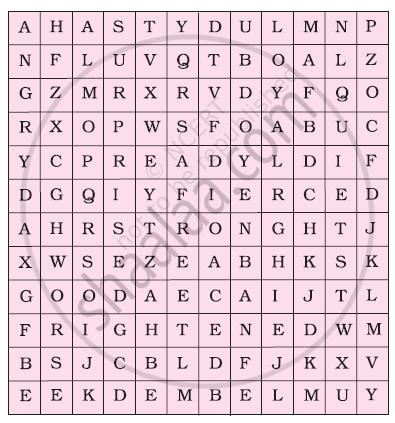
With your partner, complete the following sentence in your own word using the ideas in the poem.
English is a __________________ with words that everyone can play.
Add im- or in- to each of the following words and use them in place of the italicised words in the sentences given below.
| patient, proper, possible, sensitive, competent |
"Don’t lose patience. Your letter will come one day," the postman told me.
'The eight other athletes stopped in their tracks' means that they ______.
