Advertisements
Advertisements
प्रश्न
Complete the following sentence
It is mysterious because ______
Advertisements
उत्तर
It is mysterious because the poet was unable to comprehend what the fan was saying.
संबंधित प्रश्न
Thinking about the Poem
How does the poet speak to the wind — in anger or with humour? You must also have
seen or heard of the wind “crumbling lives”. What is your response to this? Is it like the
poet’s?
The poem you have just read is originally in the Tamil. Do you know any such poems in your language?
What are the things the child sees on his way to the fair? Why does he lag behind?
I wandered lonely as a Cloud
That floats on high o'er vales and Hills,
When all at once I saw a crowd,
A host, of golden Daffodils;
Beside the Lake, beneath the trees,
Fluttering and dancing in the breeze.
Read the lines given above and answer the question that follow.
Who does he come across while wandering ?
There was a time when our people covered the land as the waves of a wind-ruffled sea cover its shell-paved floor, but that time long since passed away with the greatness of tribes that are now but a mournful memory. 1 will not dwell on, nor mourn over, our untimely decay, nor reproach my paleface brothers with hastening it, as we too may have been somewhat to blame.
Youth is impulsive. When our young men grow angry at some real or imaginary wrong, and disfigure their faces with black paint, it denotes that their hearts are black, and that they are often cruel and relentless, and our old men and old women are unable to restrain them. Thus it has ever been. Thus it was when the white man began to push our forefathers ever westward. But let us hope that the hostilities between us may never return. We would have everything to lose and nothing to gain. Revenge by young men is considered gain, even at the cost of their own lives, but old men who stay at home in times of war, and mothers who have sons to lose, know better.
Read the extract given below and answer the question that follow.
What does Chief Seattle tell about the condition of his people earlier?
He flungs himself down in a corner to recoup from the fatigue of his visit to the shop. His wife said, “You are getting no sauce today, nor anything else. I can’t find anything to give you to eat. Fast till the evening, it’ll do you good. Take the goats and be gone now,” she cried and added, “Don’t come back before the sun is down.”
Read the extract given below and answer the question that follow.
What lie did Muni tell the shopkeeper?
The horse was nearly life-size, moulded out of clay, baked, burnt, and brightly coloured, and reared its head proudly, prancing its forelegs in the air and flourishing its tail in a loop; beside the horse stood a warrior with scythelike mustachios, bulging eyes, and aquiline nose. The old image-makers believed in indicating a man of strength by bulging out his eyes and sharpening his moustache tips, and also decorated the man’s chest with beads which looked today like blobs of mud through the ravages of sun and wind and rain (when it came), but Muni would insist that he had known the beads to sparkle like the nine gems at one time in his life.
Read the extract given below and answer the question that follow.
What was the effect of the construction of the highway?
In what ways is an ant’s life peaceful?
Discuss in small groups
• Is there someone of your age in the family who is very talkative? Do you find her/him interesting and impressive or otherwise? Share your ideas with others in the group.
Mark the right item.
When the old couple became rich, they
What were the replies the king received for his first question?
According to Maya what was the cause behind Mr Nath’s scars?
Describe Golu’s meeting with the crocodile.
“Trees are for apples to grow on, or pears.” Do you agree that one purpose of a tree is to have fruit on it? Or do you think this line is humorous?
Why are snakes dangerous, according to you?
Mark the right item.
Taro decided to earn extra money ______
Answer the following question.
What was the ‘game’ that every child in the school had to play?
Look at the following picture. One asks a question, the other answers it. Then the answer is noted in a form as shown below.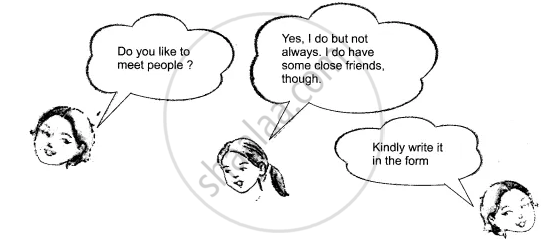
| Questions | Yes/No | Additional Response |
|
1. Do you like to meet people? |
Yes I do, but not always | I do have some close friends, though. |
|
2. Do you like the area you live in? |
No, I Don't | But I have no choice |
Why does the speaker say that “there isn’t anyone staring or making strange noises”?
The words helper, companion, partner and accomplice have very similar meanings, but each word is typically used in certain phrases. Can you fill in the blanks below with the most commonly used words? A dictionary may help you.
my ……………. on the journey.
