Advertisements
Advertisements
प्रश्न
Answer the following question
How did Gopal get inside the palace to see the king after he had bought the fish?
Advertisements
उत्तर
After he had bought the fish, Gopal reached the palace and told the guards that he wanted to see the king. When the guards did not let him in, he began to dance and sing loudly. When the king heard this, and also the comments of the people watching the man sing and dance, he asked for the man to be brought before him.
संबंधित प्रश्न
Bill Bryson says, “I am, in short, easily confused.” What examples has he given to justify this?
Look at the following sentences. They each have two clauses, or two parts each with their own subject and verb or verb phrase. Often, one part (italicised) tells us when or why something happened.
• I reached the market when most of the shops had closed. (Tells us when I reached.)
• When Rahul Dravid walked back towards the pavilion, everyone stood up. (Tells us when everyone stood up.)
• The telephone rang and Ganga picked it up. (Tells us what happened next.)
• Gunjan has been with us ever since the school began. (Tells us for how long he has been with us.)
I. Identify the two parts in the sentences below by underlining the part that gives us the information in brackets.
1. Where other girls wore traditional Indian dresses, Santosh preferred shorts.
(Contrasts her dress with that of others)
2. She left home and got herself enrolled in a school in Delhi. (Tells us what happened after the first action.)
3. She decided to fight the system when the right moment arrived. (Tells us when she was going to fight the system.)
4. Little Maria had not yet celebrated her tenth birthday when she was packed off to train in the United States. (Tells us when Maria was sent to the U.S.)
(a) Given below are five lines from a poem but they are not in the right order.
Get into groups of four. Read the lines and put them in the right order. Read the version that you develop to the whole class.
| The voice of thunder declares my arrival. |
| I emerge from the heart of the sea. |
| I descend and embrace the flowers. |
| I am dotted silver threads dropped from heaven. |
| The rainbow announces my departure. |
(b) Who is ‘I’ in these lines?
(c) Imagining yourself as the subject of this poem, write five lines about yourself in less than five minutes.
You may like to
- define yourself
- state what you do
- explain why people like/dislike you
- mention any other characteristic about yourself
In line 35, the poet has misspelt the word ‘amalgum’. Why do you think she has done that? Discuss.
Now dramatise the play. Form groups of eight to ten students. Within each group, you will need to choose
- a director, who will be overall incharge of the group’s presentation.
- the cast, to play the various parts.
- someone to be in charge of costumes.
- someone to be in charge of props.
- a prompter.
Within your groups, do ensure that you
- read both scenes, not just your part within one scene if you are acting.
- discuss and agree on the stage directions.
- read and discuss characterization.
- hold regular rehearsals before the actual presentation.
Staging
The stage can be very simple, with exits on either side representing doors to the outside and to the rest of the house respectively.
Understanding determiners.
Determiners are words that are used in front of nouns to indicate whether you are
referring to something specific or something of a particular type.
Singular nouns always need a determiner. In plural nouns, the determiner is
optional. Determiners may or may not be used with uncountable nouns depending
on context.
There are about 50 different determiners in the English language which include:
Articles: a, an, the
Possessives: my, your, our, their, his, hers, whose, etc.
Demonstratives: this, that these, those, which, etc.
Quantifiers: few, a few, many, much, each, every, some, any, etc.
Number: one, two, three, twenty, forty, etc.
Ordinals: first, second, last, next, etc.
Determiners are used
• to state the unit/ number of people, things or other nouns.
• to state possessives.
• to specify someone or something.
• to state how things or people are distributed.
• to state the difference between nouns.
Determiners can be classified under the following categories:
| EXAMPLES | ||
| MULTIPLIERS | double, twice, three times... | We want double portions. |
| FRACTIONS | half, a third, two fifths ..... | I drove at half speed. |
| INTENSIFIERS | What! Such! | Such impudence! |
| QUANTIFIERS | all, both, most | I like most people. |
| ARTICLES | a, an, the | Get a book from the shelf. |
| DEMONSTRATIVES | this, that, these, those, another, other | That tree is in another garden. |
| DISTRIBUTIVES | each, every, either, neither | I have a gift for each person. |
| POSSESSIVES | ||
| (i) PRONOMINAL | my, your, his, her, its, our, your, their | You can borrow Kim's video. |
| (ii) NOMINAL | Renata's, Adam's, People's ... | You can borrow my video. |
| INTERROGATIVES | What? Which? Whose? | Whose book is that? |
| QUANTIFIERS | some, any, no | I have no problem with them. |
| CARDINAL NUMBERS | one, two, three hundred ..... | Two heads are better than one. |
| ORDINAL NUMBERS | first, fewer, much, more, less, least ......... . | It was my first tennis match. |
| QUANTIFIERS | ||
| (i) SIMPLE | few, fewer, much, more, less, least ........... . |
I have few pals; Kim has more. |
| (ii) COMPOUND | a little, a lot of, a great deal of .... |
I have lots of time to spare. |
Read the comic strip based on. H.G. Wells' novells.


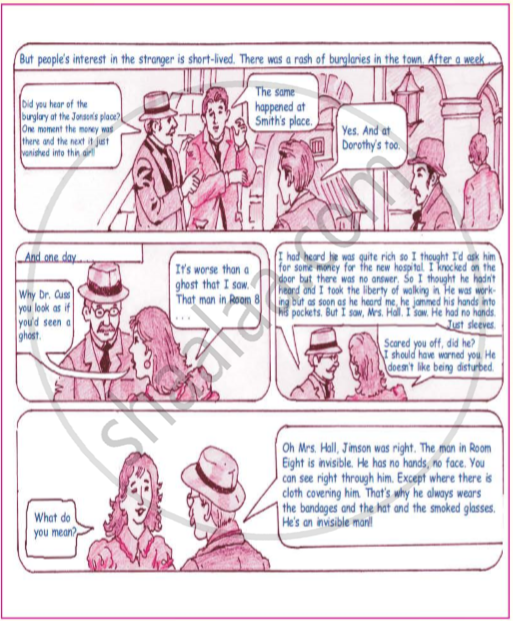
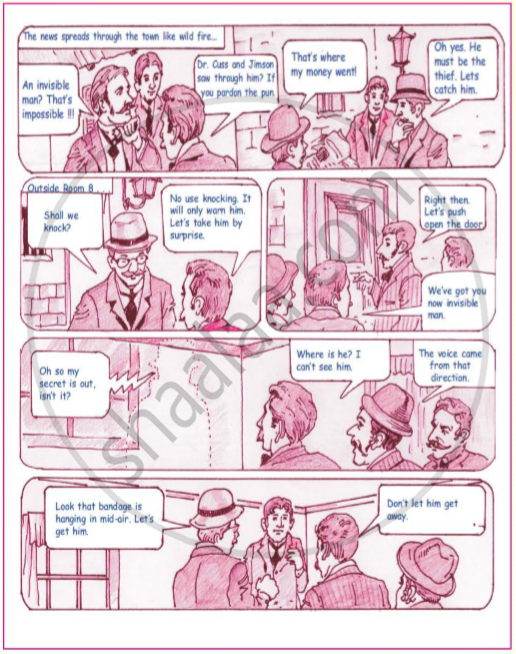
Answer the questions by ticking the correct option.
(a) The strange-looking man wanted ....
(i) the best room at the inn.
(ii} a room with a fire and a good lock.
(iii} a room with a good view.
(iv) a room where he could work quietly.
(b) Jimson was suspicious of the stranger because ...
(i} he did not answer Jimson's questions.
(ii} he did not want to talk about the weather.
(iii} he kept his back turned towards Jimson at all times.
(iv) he shouted atJimson when he entered his room.
(c) The people of the town gossiped about the stranger as ...
(i} he did not go out or talk to anyone in the town.
(ii} he had met with an accident and his face was bandaged.
(iii} he was new to the town and behaved rudely.
(iv) he stayed in his room and did not show his face to anyone.
(d) 'There was a rush of burglaries in the town. This means that ________
(i} there were many robberies in the town.
(ii) a few people in the town had seen a rob her.
(iii} the burglaries in the town were done in a rush.
(iv) the burglar was a rash and careless man.
(e) Although Jimson and Dr Cuss are suspicious of the strange guest, Mrs Hall tolerates him because ....
(i} she is not superstitious or ignorant.
(ii) she is sorry for the stranger who is bandaged.
(iii} the stranger is paying her a good amount of money for the room.
(iv} the stranger is polite and kind to Mrs Hall at all times.
(f) The stranger who was staying at the inn can be described as being ....
(I} violent
(ii} upright
(iii} dishonest
(iv) sensible
Of the seven hundred villages dotting the map of India, in which the majority of India’s five hundred million live, flourish and die, Kritam was probably the tiniest, indicated on the district survey map by a microscopic dot, the map being meant more for the revenue official out to collect tax than for the guidance of the motorist, who in any case could not hope to reach it since it sprawled far from the highway at the end of a rough track furrowed up by the iron-hooped wheels of bullock carts. But its size did not prevent its giving itself the grandiose name Kritam, which meant in Tamil coronet or crown on the brow of the subcontinent. The village consisted of fewer than thirty houses, only one of them built from brick and cement and painted a brilliant yellow and blue all over with
gorgeous carvings of gods and gargoyles on its balustrade, it was known as the Big House. The other houses, distributed in four streets, were generally of bamboo thatch, straw, mud and other unspecified material. Muni’s was the last house in the fourth street, beyond which stretched the fields. In his prosperous days Muni had owned a flock of sheep and goats and sallied forth every morning driving the flock to the highway a couple of miles away.
Read the extract given below and answer the question that follow.
Name the village in which Muni lived.
From the day, perhaps a hundred years ago when he sun had hatched him in a sandbank, and he had broken his shell, and got his head out and looked around, ready to snap at anything, before he was even fully hatched-from that day, when he had at once made for the water, ready to fend for himself immediately, he had lived by his brainless craft and ferocity. Escaping the birds of prey and the great carnivorous fishes that eat baby crocodiles, he has prospered, catching all the food he needed, and storing it till putrid in holes in the bank. Tepid water to live in and plenty of rotted food grew him to his great length. Now nothing could pierce the inch-?thick armoured hide. Not even rifle bullets,
which would bounce off. Only the eyes and the soft underarms offered a place. He lived well in the river, sunning himself sometimes with other crocodiles-muggers, as well as the long-? snouted fish-?eating gharials-on warm rocks and sandbanks where the sun dried the clay on them quite white, and where they could plop off into the water in a moment if alarmed. The big crocodile fed mostly on fish, but also on deer and monkeys come to drink, perhaps a duck or two.
Read the extract given below and answer the question that follow.
What protected him now? How?
How long does it take for a grub to become a complete ant?
Compare how the music teacher played the violin with that of Lalli’s.
What made the farmer’s wife first kill the mongoose and then repent soon after?
Have you seen animals or birds making houses in trees?
Read the newspaper report to find the following facts about Columbia’s ill-fated voyage.
Number of astronauts on board: ____________
Multiple Choice Question:
Inner beauty of a person is shown in______
Answer the question.
What do you think these phrases from the poem mean?Leave their greens.
Multiple Choice Question:
Which one of the following mistakes the child does not make?
Study the following phrases and their meanings. Use them appropriately to complete the sentences that follow.
If you want to go out, I will ………….. the children for you.
In the Masque in Act IV of the play The Tempest, how does Ceres know that Juno is coming?
Which of the following words does H. W. Longfellow use to describe the movement of the phantoms in his poem, ‘Haunted Houses’?
