Advertisements
Advertisements
प्रश्न
How did the dog repay to his masters?
Advertisements
उत्तर
The dog made his masters rich by giving them gold coins. His masters became prosperous with it and bought a piece of land. He then asked them to collect the ashes which had the power to sprout blossoms of a withered tree. This magic was seen by the daimio and rewarded the old couple for this magic.
संबंधित प्रश्न
From the text on Bismillah Khan, find the words and phrases that match these
definitions and write them down. The number of the paragraph where you will find the
words/phrases has been given for you in brackets.
1. the home of royal people (1) _____ .
2. the state of being alone (5) _____ .
3. a part which is absolutely necessary (2)_____ .
4. to do something not done before (5) _____ .
5. without much effort (13) _____ .
6. quickly and in large quantities (9) _____ and _____ .
Think of an occasion when you participated in a team competition. Think back on the leadership qualities displayed by your Team Leader/Captain. Recollect the specific incidents when those were displayed and how they contributed to the success of the team.
Write an e-mail to your mentor-teacher sharing this experience.
The Process of Writing : CODER
In your written work, it is advisable to follow the process outlined below. (We call it 'CODER' - Collect your ideas; Organise your ideas; make your first Draft; Edit your work; Revise your work.)
1. C - Collect your ideas
Working in groups, recall and jot down the opinion that the 'scientist' formed of his boss in A.5.
2. 0 - Organise your ideas
(a) Now work in pairs. Choose one or two opinions about the boss that you feel quite strongly about, or agree with.
(b) Also, note down the opinion that you prefer about the scientist.
3. D - make your first Draft
Write the description individually. You may refer to some of the words in the boxes in A.2. and A. 7.
Note : At this stage of your course, you should not worry about the language and tone of a formal description.
4. E -Edit your work
Now exchange your description with your partner, and suggest improvements in grammar, spelling, punctuation etc.
5. R - Revise your work
Rewrite your speech and check it carefully, before handing it to your teacher.
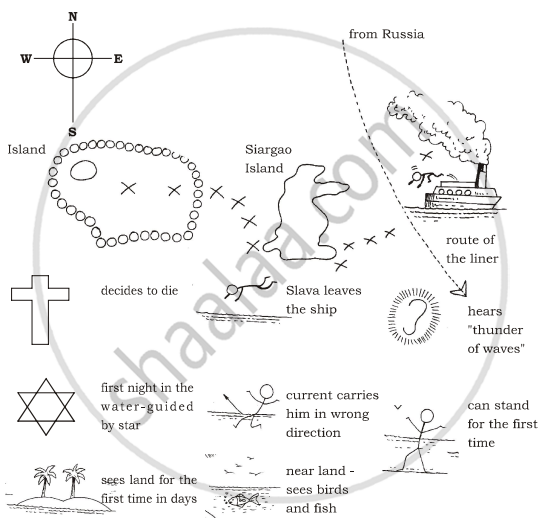
Given below is a map of the area in which Slava Kurilov faced his ordeal. You will also see the major events in the story, in mixed order, each accompanied by a symbol. After you have read ‘Ordeal in the Ocean’, draw the appropriate symbol against each x mark. (One is already drawn for you.) Draw the symbols or number the symbols, and transfer them to the map.)
What does he plant who plants a tree?
He plants cool shade and tender rain,
And seed and bud of days to be,
And years that fade and flush again;
He plants the glory of the plain;
He plants the forest's heritage;
The harvest of a coming age;
The joy that unborn eyes shall see___
These things he plants who plants a tree.
Read the lines given above and answer the question that follow:
Explain with reference to context.
A free bird leaps on the back
Of the wind and floats downstream
Till the current ends and dips his wing
In the orange suns rays
And dares to claim the sky.
Read the above lines and answer the question that follow.
Which birds are used to describe the state of the free bird?
The blocks were all lined up for those who would use them
The hundred-yard dash and the race to be run
These were nine resolved athletes in back of the starting line
Poised for the sound of the gun.
The signal was given, the pistol exploded
And so did the runners all charging ahead
But the smallest among them,he stumbled and staggered
And fell to the asphalt instead.
He gave out a cry in frustration and anguish
His dreams ands his efforts all dashed in the dirt
But as sure I'm standing here telling this story
The same goes for what next occurred.
Read the lines given above and answer the following question:
What happened when the gun was fired?
To us the ashes of our ancestors are sacred and their resting place is hallowed ground. You wander far from the graves of your ancestors and seemingly without regret. Your religion was written upon tablets of stone by the iron finger of your God so that you could not forget. The Red Man could never comprehend or remember it. Our religion is the traditions of our ancestors — the dreams of our old men, given them in solemn hours of the night by the Great Spirit; and the visions of our sachems, and is written in the hearts of our people.
Day and night cannot dwell together. The Red Man has ever fled the approach of the White Man, as the morning mist flees before the morning sun. However, your proposition seems fair and I think that my people will accept it and will retire to the reservation you offer them. Then we will dwell apart in peace, for the words of the Great White Chief seem to be the words of nature speaking to my people out of dense darkness.
Read the extract given below and answer the question that follow.
How do the tribal men regard the ashes of their ancestors?
He flungs himself down in a corner to recoup from the fatigue of his visit to the shop. His wife said, “You are getting no sauce today, nor anything else. I can’t find anything to give you to eat. Fast till the evening, it’ll do you good. Take the goats and be gone now,” she cried and added, “Don’t come back before the sun is down.”
Read the extract given below and answer the question that follow.
Did The shopkeeper give Muni what he needed? Why/ Why not?
The women came out on the shore, and made for the stepping—?stones. They had plenty to laugh and bicker about, as they approached the river in a noisy crowd. They girded up their skirts, so as to jump from stone to stone, and they clanked their sickles and forks together over their shoulders to have ease of movement. They shouted their quarrels above the gush of the river. Noise frightens crocodiles. The big mugger did not move, and all the women crossed in safety to the other bank. Here they had to climb a steep hillside to get at the grass, but all fell to with a will, and sliced away at it wherever there was foothold to be had. Down below them ran the broad river, pouring powerfully out from its deep narrow pools among the cold cliffs and shadows, spreading into warm shallows, lit by kingfishers. Great turtles lived there, and mahseer weighing more than a hundred pounds. Crocodiles too. Sometimes you could see them lying out on those slabs of clay over there, but there were none to be seen at the moment.
Read the extract given below and answer the question that follow.
What did the women carry?
How did the rishi explain the different ways in which the birds behaved?
How did the old clock give a timeless message through Ray?
Make a sentence of your own using the word ‘drag.’
Which word in the extract means, ‘holes’?
Talk to your partner and say whether the following statement is true or false.
Most snakes are harmless.
Answer the following question.
“Then the situation changed.” What is being referred to?
What decisions were given by Algu and Jumman as head Panch?
Fill in the blanks with the words given in the box.
| how, what, when, where, which |
"You should know ______ to talk and ______ to keep your mouth shut," the teacher advised Anil.
Complete the following sentence by providing a reason:
Towards the end of the story B. Wordsworth, the poet told the boy to never visit him because ______.
Choose the option that lists the sequence of events from Alphonse Daudet’s short story ‘The Last Lesson’ in the correct order.
- But, when he arrived at school, Franz was dismayed to find his classmates already seated quietly and solemnly in their places ... and shocked when M. Hamel simply urged him to take his place.
- Franz hurried to school that morning he was very late and dreaded being scolded by M. Hamel, the teacher.
- After he had settled at his desk, he noticed something really odd: the back benches of the classroom were occupied by adults from the village!
- He hoped to slip into the classroom unnoticed, under cover of the bustle and noise of a typical school day morning.
