Advertisements
Advertisements
प्रश्न
Complete the following sentence
It is mysterious because ______
Advertisements
उत्तर
It is mysterious because the poet was unable to comprehend what the fan was saying.
संबंधित प्रश्न
Expressions used to show fear
Can you find the expressions in the story that tell you that the author was frightened?
Read the story and complete the following sentences.
1. I was turned ______.
2. I sat there holding ______.
3. In the light of the lamp I sat there like ______.
Discuss in pair and answer question below in a short paragraph (30 − 40 words.
Where did Jerome finally find the toothbrush?
Thinking about the poem
What do you think the last two lines of the poem mean? (Looking back, does the poet regret his choice or accept it?)
After having read the story, you realise the anguish of the illiterate adults. You want to make your friends aware of it and contribute something in bringing about a change in the lives of the illiterate adults. Deliver a speech in the morning assembly at your school about the Importance of Adult Education and ways to implement it.
Read the following to make your speech effective:
The introduction of a speech is like the nose of an airplane. The nose sets the course and leads the plane off in a specific direction. A good introduction sets the direction of your speech by
- getting the attention of your audience
- introducing your topic
- stating your central idea or purpose
- briefly identifying the main points
- making your audience eager to hear what you have to say
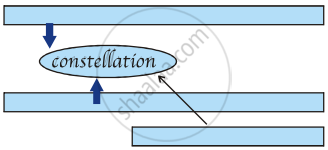
Read the following extracts from the story, and try to puzzle out the meanings of the encircled words from other words and phrases in the extract. Write the clues in the empty boxes. Then give your own explanation of the encircled words.
I saw individual stars, but I could not distinguish the constellation they belonged to. Then dawn came and put out all my stars.
Therefore, constellation means ______.
Six humans trapped by happenstance
In black and bitter cold.
Each one possessed a stick of wood,
Or so the story's told.
Their dying fire in need of logs;
The first man held his back.
For on the faces around the fire,
He noticed one was black.
Read the lines given above and answer the question that follow:
What is suggested by the use of the word trapped?
Six humans trapped by happenstance
In black and bitter cold.
Each one possessed a stick of wood,
Or so the story's told.
Their dying fire in need of logs;
The first man held his back.
For on the faces around the fire,
He noticed one was black.
Read the lines given above and answer the question that follow:
Explain the symbolism used by the poet.
"Now tell us what 'twas all about,"
Young Peterkin, he cries;
And little wilhelmine looks up
with wonder-waiting eyes;
"Now tell us all about the war,
And what they fought each other for."
"It was the English," Kaspar cried,
"Who put the French to rout;
But what they fought each other for,
I could not well make out;
But everybody said,"quoth he,
"That 'twas a famous victory.
Read the lines given above and answer the question that follow.
Did the children wonder about the reason for the war?
'All right!' you 'll cry.'All right!' you'll say,
'But if we take the set away,
What shall we do to entertain
Our darling children?Please explain!'
We'll answer this by asking you,
'What used the darling ones to do?
'How used they keep themselves contented
Before this monster was invented?'
Have you forgotten? Don't you know?
We'll say it very loud and slow:
THEY ... USED ... TO ... READ! They'd READ and READ,
AND READ and READ, and then proceed
To READ some more. Great Scott! Gadzooks!
One half their lives was reading books!
The nursery shelves held books galore!
Books cluttered up the nursery floor!
And in the bedroom, by the bed,
More books were waiting to be read!
Read the lines given above and answer the question given below.
Explain with reference to context.
The athletes had come from all over the country
To run for the gold, for the silver and bronze
Many weeks and months of training
All coming down to these games.
The spectators gathered around the old field
To cheer on all the young women and men
The final event of the day was approaching
Excitement grew high to begin.
Read the lines given above and answer the following question:
Were the contestants well prepared for the event? Pick the line that illustrates this.
At Denver there was an influx of passengers into the coaches on the eastbound B. & M. express. In one coach there sat a very pretty young woman dressed in elegant taste and surrounded by all the luxurious comforts of an experienced traveler. Among the newcomers were two young men, one of handsome presence with a bold, frank countenance and manner; the other a ruffled, glum-faced person, heavily built and roughly dressed. The two were handcuffed together.
As they passed down the aisle of the coach the only vacant seat offered was a reversed one facing the attractive young woman. Here the linked couple seated themselves. The young woman’s glance fell upon them with a distant, swift disinterest; then with a lovely smile brightening her countenance and a tender pink tingeing her rounded cheeks, she held out a little gray-gloved hand. When she spoke her voice, full, sweet, and deliberate, proclaimed that its owner was accustomed to speak and be heard.
“Well, Mr. Easton, if you will make me speak first, 1 suppose 1 must. Don’t vou ever recognize old friends when you meet them in the West?”
The younger man roused himself sharply at the sound of her voice, seemed to struggle with a slight embarrassment which he threw off instantly, and then clasped her fingers with his left hand.
He slightly raised his right hand, bound at the wrist by the shining “bracelet” to the left one of his companion.
Read the extract given below and answer the question that follow.
Describe the young woman in the coach.
Discuss the following topic in groups.
Do you think there is life on other planets? Can you guess what kind of people there may be on them? In what ways are they likely to be different from us?
Complete the following sentences by adding the appropriate parts of the sentences given below.
Someone suggested that there should be a council of wise men______________________.
According to Charlie, what lives the longest.
Why did Abbu Khan feel sad?
To what use a mother puts the trees?
Do you agree with what the poet says? Talk to your partner and complete these sentences.
(i) A house is made of ____________.
(ii) It has ____________.
(iii) A home is made by ____________.
(iv) It has ____________.
Multiple Choice Question:
What does the word “marvellous’ mean?
Replace the italicised portion of the sentence below with a suitable phrase from the box. Make necessary changes, wherever required.
The patient needs to be properly taken care of.
Your partner and you may now be able to answer the question.
From the way the child envies the hawker, the gardener, and the watchman, we can guess that there are many things the child has to do, or must not do. Make a list of the do’s and don’ts that the child doesn’t like. The first line is done for you.
| The child must come home at a fixed time. | The child must not get his clothes dirty in the dust. |
|
|
|
Now add to the list your own complaints about the things you have to do, or must not do.
