Advertisements
Advertisements
प्रश्न
What does this passage say about the speaker?
Advertisements
उत्तर
The passage indicates a mature : understanding that the speaker has attained.
संबंधित प्रश्न
Tick the right answer.
When a government bans something, it wants it (stopped/started).
Use suitable words or phrases from Column A above to complete the paragraph given below.
A Traffic Jam
During power cuts, when traffic lights go off, there is utter ____ at crossroads. Drivers add
to the confusion by ____ over their right of way, and nearly come to blows. Sometimes
passers-by, seeing a few policemen ____ at regulating traffic, step in to help. This gives
them a feeling of having ____ something.
Read the newspaper clipping.

Listen to an interview between the police inspector in charge of the case, the housekeeper, Ms. Lakshmi and the watchman, Ram Singh. As you listen, note down the details of the burglar.
Inspector: Hello, madam. I am Inspector Maan Singh. I am in charge of the burglary
case which occurred in the flat of your employer, Mr. Ravikant. It must have
been a harrowing experience for you.
Lakshmi: Yes, it was a terrible experience. People like that should be locked up in a
prison.
Inspector: If you will cooperate with us, we will catch them in no time. Were you alone
in the apartment at that time?
Lakshmi: Yes, it was 11 :30 in the night and I was alone as my master and his wife had
left for Shimla.
Inspector: How do you think the burglar gained entry into the house?
Lakshmi: He might have come through the balcony and entered my room.
Inspector: Now tell me something about his physique. What about his build? How tall
was he?
Lakshmi: He was about 6 ft tall.
Inspector: What about his physique?
Lakshmi: He was not thin. He was well-built and rather plump.
Inspector: What about his dress? What was he wearing?
Lakshmi: I think his clothes were rather old and faded. He was wearing a black shirt
which was faded.
Inspector: Do you remember the colour of his trousers?
Lakshmi: They were of a dark shade -either black or blue.
Inspector: Can you tell me something about his face?
Lakshmi: Unfortunately no. When he entered my room I panicked. But then I
gathered courage and screamed and tried to run away. But I was a bit late.
He struck me with a staff and I really don't remember anything after that.
May be I was knocked out.
Later on, I came to know that he broke into the bedroom and ran off with the
jewellery. But Ram Singh, the watchman, who tried to catch him may be
able to describe him better.
Inspector: OK Lakshmi, thank you! If I need your help I will come again. You may have
to identify the burglar. Now, I will speak to Ram Singh.
Inspector to Ram Singh:
Ram Singh you were on duty and you tried to catch the burglar. You may be
able to give a good description of him. First, tell me about his hair.
Ram Singh: He had straight black hair.
Inspector: What about the shape of his face and his complexion?
Ram Singh: He had an oval face with grey eyes and I think he was dark complexioned.
Inspector: Did he wear spectacles?
Ram Singh: Yes, with a plastic frame and his nose was rather sharp.
Inspector: What else can you remember about him? What about his teeth and lips?
Ram Singh: His lips were quite thick.
Inspector: Is there anything else that you remember about him?
Ram Singh: When I heard some noise from inside, I ran in. I tried to stop the burglar and
we had a scuffie. During the struggle I noticed that he had six fingers on his
right hand. But he managed to run away and made good his escape on a
motorbike.
Inspector: Thank you Ram Singh. We will make sketches on the basis of your
description and nab him.
| DESCRIPTION | |
| Built | |
| Height | |
| Clothes | |
| Shape of the face | |
| Complexion | |
| Eyes | |
| Hair | |
| Nose | |
| Lips | |
| Teeths | |
| Special Features |
Based on your reading of the passage, complete the statements using given connectors.
(a) The mother, father ______ thought ______ (and)
(b) They planned to walk to the woods ______ (which)
(c) They reached the place ______ in eighteen months (which)
(d) They eagerly unpacked their picnic basket ______ (but)
(e) It was ______, when the three tortoises arrived at the picnic place, (after)
(f) The mother tortoise ordered the baby to go home for the opener, saying ______ (that).
(g) ______ (but) was not willing at first.
(h) The mother and father promised to wait ______ (until)
(i) ______ they began to get very hungry, (after)
I wandered lonely as a Cloud
That floats on high o'er vales and Hills,
When all at once I saw a crowd,
A host, of golden Daffodils;
Beside the Lake, beneath the trees,
Fluttering and dancing in the breeze.
Read the lines given above and answer the question that follow.
Who wandered like a lonely cloud and where ?
“So that is what you are doing out here? A marshal!” “My dear Miss Fairchild,” said ’ Easton, calmly, “I had to do something. Money has & way of taking wings unto itself, and
you know it takes money to keep step with our crowd in Washington. I saw this opening in the West, and—well, a marshalship isn’t quite as high a position as that of ambassador, but—” “The ambassador,” said the girl, warmly, “doesn’t call any more. He needn’t ever have done so. You ought to know that. And so now you are one of these dashing Western heroes, and you ride and shoot and go into all kinds of dangers. That’s different from the Washington life. You have been missed from the old crowd.” The girl’s eyes, fascinated, went back, widening a little, to rest upon the glittering handcuffs. “Don’t you worry about them, miss,” said the other man. “All marshals handcuff themselves to their prisoners to keep them from getting away. Mr. Easton knows his business.” “Will we see you again soon in Washington?” asked the girl. “Not soon, I think,” said Easton. “My butterfly days are over, I fear.”
Read the extract given below and answer the question that follow.
Give three similarities between Mr Easton and a butterfly.
Mrs. Thompson did not reply, but presently turned towards the little chamber where her husband had deposited Maggie; and, pushing open the door, went quietly in. Joe did not follow; he saw that, her state had changed, and felt that it would be best to leave her alone with the child. So he went to his shop, which stood near the house, and worked until dusky evening released him from labor. A light shining through the little chamber windows was the first object that attracted Joe’s attention on turning towards the house: it was a good omen. The path led him by this windows and, when opposite, he could not help pausing to look in. It was now dark enough outside to screen him from observation. Maggie lay, a little raised on the pillow with the lamp shining full upon her face. Mrs. Thompson was sitting by the bed, talking to the child; but her back was towards the window, so that her countenance was not seen. From Maggie’s face, therefore, Joe must read the character of their intercourse. He saw that her eyes were intently fixed upon his wife; that now and then a few words came, as if in answers from her lips; that her expression was sad and tender; but he saw nothing of bitterness or pain. A deep-drawn breath was followed by one of relief, as a weight lifted itself from his heart.
Read the extract given below and answer the question that follow.
What did Joe see from the window?
It was the summer of 1936. The Olympic Games were being held in Berlin. Because Adolf Hitler childishly insisted that his performers were members of a “master race,” nationalistic feelings were at an all-time high.
I wasn’t too worried about all this. I’d trained, sweated and disciplined myself for six years, with the Games in mind. While I was going over on the boat, all I could think about was taking home one or two of those gold medals. I had my eyes especially on the running broad jump. A year before, as a sophomore at the Ohio State, I’d set the world’s record of 26 feet 8 1/4 inches. Nearly everyone expected me to win this event.
Read the extract given below and answer the question that follow.
Who is Jesse Owens?
Mark the right item.
The old farmer and his wife loved the dog
Which line in the poem suggests that you need a keen eye and a sharp ear to enjoy a meadow? Read aloud the stanza that contains this line.
What does a garden snake eat?
What does the child’s mother say about snakes?
There are twelve words hidden in this table. Six can be found horizontally and the remaining six vertically. All of them are describing words like ‘good’, ‘happy’, etc. The first letters of the words are given below:
Horizontal: H R F F S G
Vertical: A W S F L Q 2020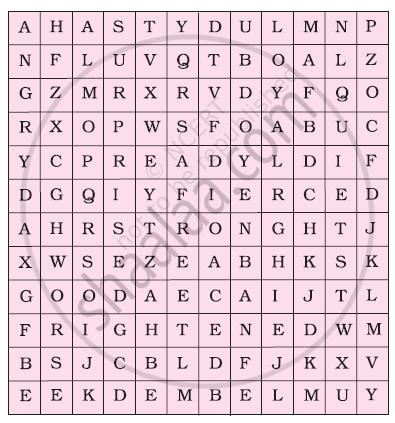
Read the following passage and do the exercises that follow. Then complete the family tree of dogs given on the facing page.
The Dog Family
The dog family is one of the 11 families that make up the Carnivores, a large group of intelligent, flesh-eating, backboned animals. In this group are such varied animals as bears, pandas, raccoons, cats, hyenas, and even seal. The dog or canine family has many wild species like wolves, foxes, coyotes, jackals, and wild dogs. The dog is the only domesticated member of the canine family though now and then someone tames a wolf, fox or coyote as a pet. All members of the dog family are descendants of a wolf-like animal which lived about 15 million years ago. From this distant ancestor, the true dogs gradually developed. But nobody knows the exact ancestor of the modern domestic dog.
Several wild dogs look and behave like domestic dogs. The dingo or wild dog of Australia is one of these. It is possible that the dingo was a tamed dog brought to Australia long ago which then ran wild. Dogs were the first animals tamed by humans — perhaps 20,000 years ago. Tamed dogs were brought from Asia to the New World 5,000 or more years ago. Dogs were first used for hunting.
Find the opposites of these words in the text above.
(i) ancestor _________
(ii) wild t _ m _
(iii) ancient _________
(iv) near d _______ t
(v) suddenly gr ___________
Complete the following sentences.
(i) The dingo is __________________________________________________.
(ii) Dogs were the ____________________________________________animals tamed by humans. The other animals tamed by humans are __________________________
_________________ (Think and name some other such animals.)
(iii) The New World refers to ___________________________.
Dogs were brought there from ________________________.
Family Tree of Dogs
Complete the following sentence.
The banyan tree served the boy as a ________.
creatures lost their lives in the classic struggle between the cobra and the mongoose. Who were those victims?
How do you define or describe a desert? Name some common desert animals. How do they survive?
Talk to your partner and say whether the following statement is true or false.
No animal can survive without water.
Read the extract given below and answer the questions that follow:
| An angry athlete is an athlete who will make mistakes, as any coach will tell you. I was no exception. On the first of my three qualifying jumps, I leaped from several inches beyond the take-off board for a foul. |
- When and where is this narrative set? [2]
- What reason does the narrator Jesse Owens give for the heightened nationalistic feelings at this time? [2]
- In which event had Owens been confident of winning a gold medal? Why? [3]
- What had made Owens angry enough to make mistakes? Name Owens’ rival who approached him at this point. [3]
Complete the following sentence by providing a reason.
Beethoven amputated the legs of his piano because ______.
