Advertisements
Advertisements
प्रश्न
What, according to the python, were the advantages of a long nose (trunk)?
Advertisements
उत्तर
A fly stung Golu on the shoulder. Golu hit the fly with his long nose (trunk). The fly lay dead Golu plucked a large bundle of grass, dusted it against his forelegs. He stuffed the grass into his mouth with the help of his long nose (trunk). The sun was very hot. Golu dug out some mud from the bank with the help of his long nose. He slopped the mud on his head. Golu could not do any of the above activities with a small nose. These were all the advantages of the long nose (trunk), according to the python.
संबंधित प्रश्न
Answer of these question in two or three paragraphs (100 –150 words).
Do you agree with Margie that schools today are more fun than the school in the story?
Give reasons for your answer.
Match the meanings with the words/expressions in italic, and write the appropriate
meaning next to the sentence.
Wait until I tell his story — it will make your hair stand on end.
- Why did Abdul Kalam want to leave Rameswaram?
- What did his father say to this?
- What do you think his words mean? Why do you think he spoke those words?
The next man looking 'cross the way
Saw one not of his church
And Couldn't bring himself to give
The fire his stick of birch.
The third one sat in tattered clothes.
He gave his coat a hitch.
Why should his log be put to use
To warm the idle rich?
The rich man just sat back and thought
of the wealth he had in store
And how to keep what he had earned
From the lazy shiftless poor.
Read the lines given above and answer the question that follow.
In stanza 3, why did the man refuse to use his stick of wood?
Some are meet for a maiden's wrist,
Silver and blue as the mountain mist,
Some are flushed like the buds that dream
On the tranquil brow of a woodland stream,
Some are aglow with the bloom that cleaves
To the limpid glory of new born leaves
Read the lines given above and answer the question that follow.
Explain :
Some are aglow with the bloom that cleaves
To the limpid glory of new born leaves.
The blocks were all lined up for those who would use them
The hundred-yard dash and the race to be run
These were nine resolved athletes in back of the starting line
Poised for the sound of the gun.
The signal was given, the pistol exploded
And so did the runners all charging ahead
But the smallest among them,he stumbled and staggered
And fell to the asphalt instead.
He gave out a cry in frustration and anguish
His dreams ands his efforts all dashed in the dirt
But as sure I'm standing here telling this story
The same goes for what next occurred.
Read the lines given above and answer the following question:
Explain with reference to context.
Mrs. Thompson did not reply, but presently turned towards the little chamber where her husband had deposited Maggie; and, pushing open the door, went quietly in. Joe did not follow; he saw that, her state had changed, and felt that it would be best to leave her alone with the child. So he went to his shop, which stood near the house, and worked until dusky evening released him from labor. A light shining through the little chamber windows was the first object that attracted Joe’s attention on turning towards the house: it was a good omen. The path led him by this windows and, when opposite, he could not help pausing to look in. It was now dark enough outside to screen him from observation. Maggie lay, a little raised on the pillow with the lamp shining full upon her face. Mrs. Thompson was sitting by the bed, talking to the child; but her back was towards the window, so that her countenance was not seen. From Maggie’s face, therefore, Joe must read the character of their intercourse. He saw that her eyes were intently fixed upon his wife; that now and then a few words came, as if in answers from her lips; that her expression was sad and tender; but he saw nothing of bitterness or pain. A deep-drawn breath was followed by one of relief, as a weight lifted itself from his heart.
Read the extract given below and answer the question that follow.
Why did Joe not follow Mr s Thompson? What had changed her?
Beside him in the shoals as he lay waiting glimmered a blue gem. It was not a gem, though: it was sand—?worn glass that had been rolling about in the river for a long time. By chance, it was perforated right through—the neck of a bottle perhaps?—a blue bead. In the shrill noisy village above the ford, out of a mud house the same colour as the ground came a little girl, a thin starveling child dressed in an earth—?coloured rag. She had torn the rag in two to make skirt and sari. Sibia was eating the last of her meal, chupatti wrapped round a smear of green chilli and rancid butter; and she divided this also, to make
it seem more, and bit it, showing straight white teeth. With her ebony hair and great eyes, and her skin of oiled brown cream, she was a happy immature child—?woman about twelve years old. Bare foot, of course, and often goosey—?cold on a winter morning, and born to toil. In all her life, she had never owned anything but a rag. She had never owned even one anna—not a pice.
Why does the writer mention the blue bead at the same time that the crocodile is introduced?
Ans. The author mentions the blue bead at the same time that the crocodile is introduced to create suspense and a foreshadowing of the events’to happen.
Read the extract given below and answer the question that follow.
What was Sibia’s life like?
Suddenly all the tension seemed to ebb out of my body as the truth of what he said hit me. Confidently, I drew a line a full foot in back of the board and proceeded to jump from there. I qualified with almost a foot to spare.
That night I walked over to Luz Long’s room in the Olympic village to thank him. I knew that if it hadn’t been for him I probably wouldn’t be jumping in the finals the following day. We sat in his quarters and talked for two hours—about track and field, ourselves, the world situation, a dozen other things.
When I finally got up to leave, we both knew that a real friendship had been formed. Luz would go out to the field the next day trying to beat me if he could. But I knew that he wanted me to do my best—even if that meant my winning.
Read the extract given below and answer the question that follow.
How did the rivalry of Owens and Long end?
Write ‘True’ or ‘False’ against each of the following statements.
(i) Timothy and Grandfather went to Lucknow in a special compartment.
(ii) The compartment in which Grandfather and Timothy travelled had no other passenger.
(iii) Timothy and Grandfather travelled in a first-class compartment.
(vi) All passengers in the compartment thought that Timothy was a well-fed and civilized tiger.
Why did Soapy move restlessly on his seat?
What have certain doctors found about dreams?
Discuss these questions in small groups before you answer them.
When are you likely to be told this?
Say thank you.
Which line shows a complete change of the child’s attitude towards snakes? Read it aloud.
How did the old woman’s little gifts help Vijay Singh in vanquishing the ghost?
What was Patrick’s chief interest?
Multiple Choice Question:
For the child, his teacher is ________
Look at the following picture. One asks a question, the other answers it. Then the answer is noted in a form as shown below.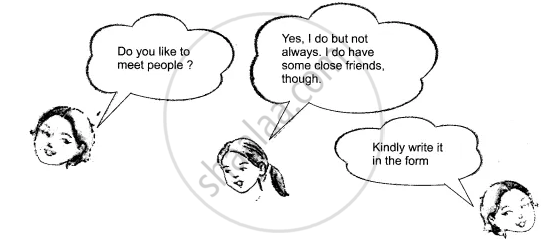
| Questions | Yes/No | Additional Response |
|
1. Do you like to meet people? |
Yes I do, but not always | I do have some close friends, though. |
|
2. Do you like the area you live in? |
No, I Don't | But I have no choice |
What does he carry in his hand?
Fill in the blanks with the words given in the box.
| how, what, when, where, which |
Do you know ______ to ride a bicycle? I don’t remember ______ and ______ I learnt it
