Advertisements
Advertisements
Question
What, according to the python, were the advantages of a long nose (trunk)?
Advertisements
Solution
A fly stung Golu on the shoulder. Golu hit the fly with his long nose (trunk). The fly lay dead Golu plucked a large bundle of grass, dusted it against his forelegs. He stuffed the grass into his mouth with the help of his long nose (trunk). The sun was very hot. Golu dug out some mud from the bank with the help of his long nose. He slopped the mud on his head. Golu could not do any of the above activities with a small nose. These were all the advantages of the long nose (trunk), according to the python.
RELATED QUESTIONS
Read the following conversation between two friends.
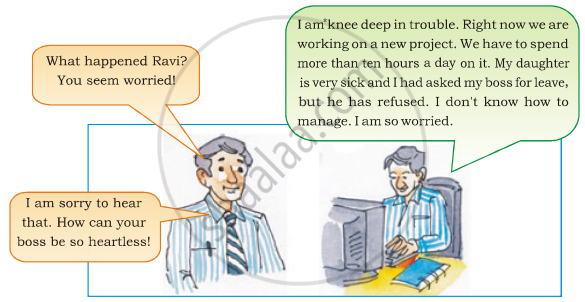
On the basis of your understanding of the poem, answer the following question
by ticking the correct option.
The rain calls itself the 'dotted silver threads' as_________.
Read the comic strip based on. H.G. Wells' novells.


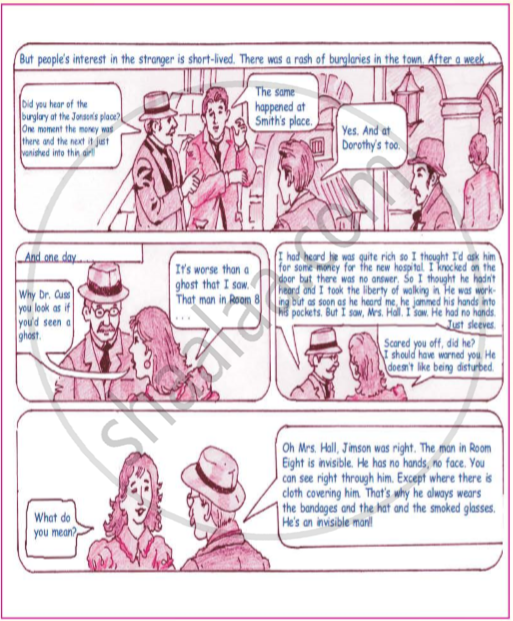
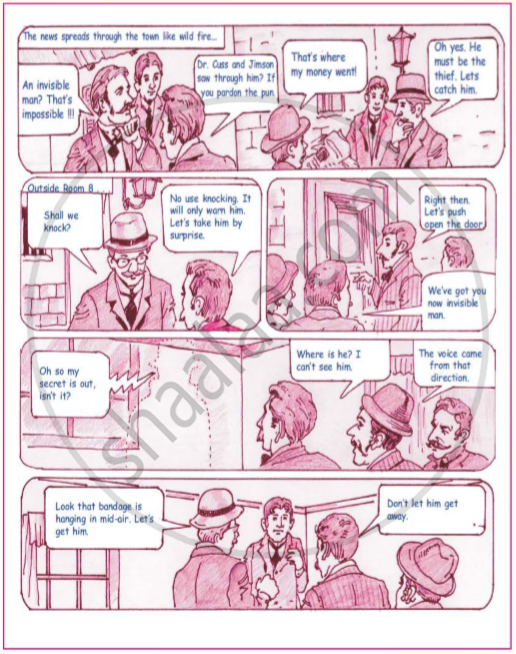
Answer the questions by ticking the correct option.
(a) The strange-looking man wanted ....
(i) the best room at the inn.
(ii} a room with a fire and a good lock.
(iii} a room with a good view.
(iv) a room where he could work quietly.
(b) Jimson was suspicious of the stranger because ...
(i} he did not answer Jimson's questions.
(ii} he did not want to talk about the weather.
(iii} he kept his back turned towards Jimson at all times.
(iv) he shouted atJimson when he entered his room.
(c) The people of the town gossiped about the stranger as ...
(i} he did not go out or talk to anyone in the town.
(ii} he had met with an accident and his face was bandaged.
(iii} he was new to the town and behaved rudely.
(iv) he stayed in his room and did not show his face to anyone.
(d) 'There was a rush of burglaries in the town. This means that ________
(i} there were many robberies in the town.
(ii) a few people in the town had seen a rob her.
(iii} the burglaries in the town were done in a rush.
(iv) the burglar was a rash and careless man.
(e) Although Jimson and Dr Cuss are suspicious of the strange guest, Mrs Hall tolerates him because ....
(i} she is not superstitious or ignorant.
(ii) she is sorry for the stranger who is bandaged.
(iii} the stranger is paying her a good amount of money for the room.
(iv} the stranger is polite and kind to Mrs Hall at all times.
(f) The stranger who was staying at the inn can be described as being ....
(I} violent
(ii} upright
(iii} dishonest
(iv) sensible
The most important thing we've learned,
So far as children are concerned,
Is never, NEVER, NEVER let
Them near your television set-----
Or better still, just don't install
The Idiotic thing at all.
In almost every house we've been,
we've watched them gaping at the screen
They loll and slop and lounge about,
And stare until their eyes pop out.
(Last week in someone's place we saw
A dozen eyeballs on the floor.
They sit and stare and stare and sit
Until they're hypnotised by it,
Until they're absolutely drunk
With all that shocking ghastly junk.
Read the lines given above and answer the question given below.
What is the most important thing that the poet has learnt?
After washing from his hands and face the dust and soil of work, Joe left the kitchen, and went to the little bedroom. A pair of large bright eyes looked up at him from the snowy bed; looked at him tenderly, gratefully, pleadingly. How his heart swelled in his bosom! With what a quicker motion came the heart-beats! Joe sat down, and now, for the first time, examining the thin free carefully under the lamp light, saw that it was an attractive face, and full of a childish sweetness which suffering had not been able to obliterate.
“Your name is Maggie?” he said, as he sat down and took her soft little hand in his.
“Yes, sir.” Her voice struck a chord that quivered in a low strain of music.
“Have you been sick long?”
“Yes, sir.” What a sweet patience was in her tone!
“Has the doctor been to see you?”
“He used to come”
“But not lately?”
“No, sir.”
Read the extract given below and answer the questions that follow.
What did Joe notice about Maggie in the light of the lamp?
Most terribly cold it was; it snowed, and was nearly quite dark, and evening— the last evening of the year. In this cold and darkness there went along the street a poor little girl, bareheaded, and with naked feet. When she left home she had slippers on, it is true; but what was the good of that? They were very large slippers, which her mother had hitherto worn; so large were they; and the poor little thing lost them as she scuffled away across the street, because of two carriages that rolled by dreadfully fast.
One slipper was nowhere to be found; the other had been laid hold of by an urchin, and off he ran with it; he thought it would do capitally for a cradle when he some day or other should have children himself. So the little maiden walked on with her tiny naked feet, that were quite red and blue from cold. She carried a quantity of matches in an old apron, and she held a bundle of them in her hand. Nobody had bought anything of her the whole livelong day; no one had given her a single farthing. She crept along trembling with cold and hunger—a very picture of sorrow, the poor little thing!
Read the extract given below and answer the question that follow.
Which day of the year was it in the story?
She lighted another match, and then she found herself sitting under a beautiful Christmas-tree. It was larger and more beautifully decorated than the one which she had seen through the glass door at the rich merchant’s. Thousands of tapers were burning upon the green branches, and colored pictures, like those she had seen in the show- windows, looked down upon it all. The little one stretched out her hand towards them, and the match went out.
The Christmas lights rose higher and higher, till they looked to her like the stars in the sky. Then she saw a star fall, leaving behind it a bright streak of fire. “Someone is dying,” thought the little girl, for her old grandmother, the only one who had ever loved her, and who was now dead, had told her that when a star falls, a soul was going up to God.
Read the extract given below and answer the question that follow.
What did she see when she lighted another match?
Read the extract given below and answer the questions that follow :
One Sunday morning Squealer announced that the hens, who just come in to lay again, must surrender their eggs.
(i) Why were the hens required to surrender their eggs?
(ii) How did the hens react to receiving this information?
(iii) The three young black Minorca pullets led the other hens in 'something resembling a rebellion'. How exactly did they do this?
(iv) What steps did Napoleon take to put down this 'rebellion'?
(v) How long did the rebellion last? Describe the consequences of the rebellion. What do you learn of Napoleon's character from the way in which he dealt with the rebellion?
The story of an ant’s life sounds almost untrue.
The underlined phrase means
Describe the stranger who came to the pet shop. What did he want?
According to Maya what was the cause behind Mr Nath’s scars?
What did the first bird say to the stranger?
- What did the iron chest contain?
- Why did the shepherd always carry it?
- Is it an example of the shepherd’s humility or wisdom or both?
Why did Vijay Singh ask the ghost to accompany him to town next day?
Why and when did Dad say the following?
Rubbish
Make noun from the word given below by adding –ness, ity, ty or y
Active ___________.
Here are some points from a similar story that you might have heard in another language. Dividing the class into two groups try and tell the story in English. One person from each group can speak alternately. Your teacher will help you. As you tell it, one of you may write it down on the board.
A Mouse Maiden
l mouse changed into a girl by a magician...
l wants to marry the strongest person...
l asks whether sun or cloud stronger (why?)...
l but mountain stronger than clouds (how?)...
l but mouse stronger than mountain (how?)...
l girl asks to marry mouse, becomes a mouse again.
(i) Like Patrick in the story ‘Who Did Patrick’s Homework’, Taro is helped by magic. Do you believe in magic? What are the magical things that happen in these stories?
(ii) Which story do you like better, and why? Do you know such stories in other languages? Discuss these questions in class.
What activities are dear to little children? Who does the child envy and why in the poem Vocation?
Read the following extract from William Wordsworth's poem, 'Daffodils' and answer the questions that follow:
|
When all at once I saw a crowd |
- Wordsworth uses the words, 'wondered' and 'lonely' to describe himself in the opening lines of the poem.
What mood do these words convey?
What let to a change in his mood? [3] - How does Wordsworth describe the sight that met his eyes?
Give a brief description of what the poet saw. [3] - To what does the poet compare this sight?
How is this comparison appropriate? [3] - What does the poet mean when he says, 'Ten thousand saw I at a glance'?
Find two other words in the given extract that create the impression of large numbers. [3] - What immediate effect did this sight have on Wordsworth?
How did it affect him in the long-term?
What does this poem tell us about Wordsworth's attitude to Nature? [4]
