Advertisements
Advertisements
प्रश्न
Describe the music teacher, as seen from the window.
Advertisements
उत्तर
As seen from the window, the bony figure of the music master, with most of his back to the window, could be seen sitting in front of Lalli. He had a mostly bald head with a fringe of oiled black hair falling around his ears and an old-fashioned tuft. A gold chain gleamed around his leathery neck and a diamond ring glittered on his hand as it glided up and down the stem of the violin. A large foot stuck out from beneath his gold-bordered veshti edge. He was beating time on the floor with the scrawny big toe.
संबंधित प्रश्न
What does Jerome say was Montmorency’s ambition in life? What do you think of
Montmorency and why?
Thinking about the Text
Answer these question.
They can’t hang me twice.”
(i) Who says this?
(ii) Why does the speaker say it?
What are the precious things mentioned in the story? Why are they precious?
Read the following statement and imagine you are Jack.
“I can’t afford to, after what Jack’s done to his teeth.” What is it, you think, you can not afford to do and why? Write a diary entry of not less than 125 words.
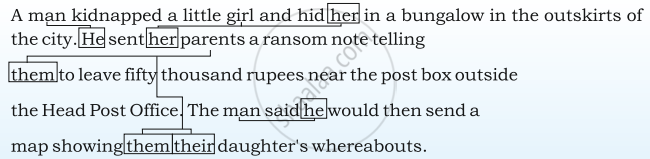
Look at the passage below and study how the personal pronouns refer to different people.
Some are like fields of sunlit corn,
Meet for a bride on her bridal morn,
Some, like the flame of her marriage fire,
Or, rich with the hue of her heart's desire,
Tinkling,luminous,tender, and clear,
Like her bridal laughter and bridal tear.
Read the lines given above and answer the question that follow.
Pick a simile from the stanza.
“So that is what you are doing out here? A marshal!” “My dear Miss Fairchild,” said ’ Easton, calmly, “I had to do something. Money has & way of taking wings unto itself, and
you know it takes money to keep step with our crowd in Washington. I saw this opening in the West, and—well, a marshalship isn’t quite as high a position as that of ambassador, but—” “The ambassador,” said the girl, warmly, “doesn’t call any more. He needn’t ever have done so. You ought to know that. And so now you are one of these dashing Western heroes, and you ride and shoot and go into all kinds of dangers. That’s different from the Washington life. You have been missed from the old crowd.” The girl’s eyes, fascinated, went back, widening a little, to rest upon the glittering handcuffs. “Don’t you worry about them, miss,” said the other man. “All marshals handcuff themselves to their prisoners to keep them from getting away. Mr. Easton knows his business.” “Will we see you again soon in Washington?” asked the girl. “Not soon, I think,” said Easton. “My butterfly days are over, I fear.”
Read the extract given below and answer the question that follow.
What reason does Easton give for not keeping up with their crowd in Wahington?
This woman had been despised, scoffed at, and angrily denounced by nearly every man, woman, and child in the village; but now, as the fact of, her death was passed from lip to lip, in subdued tones, pity took the place of anger, and sorrow of denunciation.
Neighbours went hastily to the old tumble-down hut, in which she had secured little more than a place of shelter from summer heats and winter cold: some with grave-clothes for a decent interment of the body; and some with food for the half-starving children, three in number. Of these, John, the oldest, a boy of twelve, was a stout lad, able to earn his living with any farmer. Kate, between ten and eleven, was bright, active girl, out of whom something clever might be made, if in good hands; but poor little Maggie, the youngest, was hopelessly diseased. Two years before a fall from a window had injured her spine, and she had not been able to leave her bed since, except when lifted in the arms of her mother.
“What is to be done with the children?” That was the chief question now. The dead mother would go underground, and be forever beyond all care or concern of the villagers. But the children must not be left to starve.
Read the extract given below and answer the question that follow.
What was a matter of concern now that the woman was dead?
Complete the sentence below by appropriately using anyone of the following:
if you want to/if you don’t want to/if you want him to
Don’t go to the theatre__________________.
Complete the sentence below by appropriately using anyone of the following:
if you want to/if you don’t want to/if you want him to
Don’t eat it____________________.
What did the specialist prescribe in addition to medicine?
Fans don’t talk, but it is possible to imagine that they do. What is it, then, that sounds like the fan’s chatter?
There are four pairs of rhyming words in the poem. Say them aloud.
What does a garden snake eat?
Answer the following question:
Describe Kalpana Chawla’s first mission in space.
Bring out the relevance/significance of the banyan tree in the title of Ruskin Bond’s story.
What is being compared to a gray overcoat?
“When the doctors came they said she had died of heart disease - of joy that kills."
Which one of the following explains why the short story, The Story of an Hour ends with the phrase "...of joy that kills"?
- To convey a sense of irony.
- To make the readers judge Mrs. Mallard.
- To convey Mrs. Mallard’s sheer sense of shock.
- To explain Brently Mallard’s shock at the incident.
Read the following extract from Maya Angelou’s poem, ‘When Great Trees Fall’ and answer the questions that follow:
| When great trees fall in forests, small things recoil into silence, their senses eroded beyond fear. |
- What effect does the falling of a ‘great tree’ have on the creatures of the forest? [3]
- How does the death of a great soul affect the lives of those left behind in the immediate aftermath of their passing? [3]
- What long-term effect does the death of a ‘great soul' have? [3]
- What feeling is being expressed by the following lines/phrases? [3]
- small things recoil into silence
- kind words/unsaid,
- Beand be/better. For they existed
- What is a ‘Great tree’ a metaphor for? [4]
What is the central message of Angelou’s poem, “When Great Trees Fall"?
When do you have flashes of sympathy and admiration for Lady Macbeth in the course of the play? Explain by citing examples from the Acts studied. Write your answer in about 200-250 words.
