Advertisements
Advertisements
प्रश्न
How does the poet imagine her to be, after death? Does he think of her as a person living in a very happy state (a ‘heaven’)? Or does he see her now as a part of nature? In which lines of the poem do you find your answer?
Advertisements
उत्तर
The poet's imagination does not allow him to think of his dead loved one as a person living in a very happy state or in heaven. Rather he imagines her to be a part of nature, being buried under the earth. She rotates with the earth, along with the stones, rocks and trees.
The lines in the poem which show this are as follows:
“Rolled round in earth’s diurnal course
With rocks and stones and trees.”
संबंधित प्रश्न
Answer these question in one or two words or in short phrase.
What does Vikram Seth compare to the quills of a porcupine?
Read the following sentences carefully to understand the meaning of the italicised
phrases. Then match the phrasal verbs in Column A with their meanings in Column B.
1. A communal war broke out when the princess was abducted by the neighbouring prince.
2. The cockpit broke off from the plane during the plane crash.
3. The car broke down on the way and we were left stranded in the jungle.
4. The dacoit broke away from the police as they took him to court.
5. The brothers broke up after the death of the father.
6. The thief broke into our house when we were away.
| A | B |
| (i) break out | (a) to come apart due to force |
| (ii) break off | (b) end a relationship |
| (iii) break down | (c) break and enter illegally; unlawful trespassing |
| (iv) break away (from someone) | (d) of start suddenly, (usually a fight, a war or a disease) |
| (v) break up | (e) to escape from someone’s grip |
| (vi) break into | (f) stop working |
Thinking about the Poem
Where was the snake before anyone saw it and chased it away? Where does the snake
disappear?
On the basis of your understanding of the poem, answer the following question
by ticking the correct option.
The rain calls itself the 'dotted silver threads' as_________.
The play is based on an incident in novelist Victor Hugo’s ‘Les Miserables.’ You may want to read the novel to get a better idea of the socio-economic conditions of the times and how people lived. Another novel that may interest you is ‘A Tale of Two Cities’ by Charles Dickens.
Divide the class into two groups and read a book each. Later, share your views on the book. Choose an incident from the book to dramatise and present before the class.
I wandered lonely as a Cloud
That floats on high o'er vales and Hills,
When all at once I saw a crowd,
A host, of golden Daffodils;
Beside the Lake, beneath the trees,
Fluttering and dancing in the breeze.
Read the lines given above and answer the question that follow.
Who does he come across while wandering ?
For oft, when on my couch I lie
In vacant or in pensive mood,
They flash upon that inward eye
Which is the bliss of solitude;
And then my heart with pleasure fills,
And dances with the daffodils.
Read the lines given above and answer the question that follow.
What does he mean by the ‘inward eye’?
Sibia sprang.
From boulder to boulder she came leaping like a rock goat. Sometimes it had seemed difficult to cross these stones, especially the big gap in the middle where the river coursed through like a bulge of glass. But now she came on wings, choosing her footing in midair without even thinking about it, and in one moment she was beside the shrieking woman. In the boiling bloody water, the face of the crocodile, fastened round her leg, was tugging to and fro, and smiling. His eyes rolled on to Sibia. One slap of the tail could kill her. He struck. Up shot the water, twenty feet, and fell like a silver chain. Again! The rock jumped under the blow. But in the daily heroism of the jungle, as common as a thorn tree, Sibia did not hesitate. She aimed at the reptile’s eyes. With all the force of her little body, she drove the hayfork at the eyes, and one prong went in—right in— while its pair scratched past on the horny cheek. The crocodile reared up in convulsion, till half his lizard body was out of the river, the tail and nose nearly meeting over his stony back. Then he crashed back, exploding the water, and in an uproar of bloody foam he disappeared. He would die. Not yet, but presently, though his death would not be known for days; not till his stomach, blown with gas, floated him. Then perhaps he would be found upside down among the logs at the timber boom, with pus in his eye. Sibia got arms round the fainting woman, and somehow dragged her from the water.
Read the extract given below and answer the question that follow.
How does Sibia save the woman?
I was in for a surprise. When the time came for the broad-jump trials, I was startled to see a tall boy hitting the pit at almost 26 feet on his practice leaps! He turned out to be a German named Luz Long. 1 was told that Hitler hoped to win the jump with him. I guessed that if Long won, it would add some new support to the Nazis’ “master race” (Aryan superiority) theory. After all, I am a Negro. Angr about Hitler’s ways, 1 determined to go out there and really show Der Fuhrer and his master race who was superior and who wasn’t. An angry athlete is an athlete who will make mistakes, as any coach will tell you. I was no exception. On the first of my three qualifying jumps, I leaped from several inches beyond the takeoff board for a foul. On the second jump, I fouled even worse. “Did I come 3,000 miles for this?” I thought bitterly. “To foul out of the trials and make a fool of myself ?” Walking a few yards from the pit, 1 kicked disgustedly at the dirt.
Read the extract given below and answer the question that follow.
“Did I come all the way from America for this?” I thought bitterly. “To foul out of the trials and make a fool of myself?” What does this show?
Margot stood apart from these children who could never remember a time when there wasn’t rain and rain and rain. They were all nine years old, and if there had been a day, seven years ago, when the sun came out for an hour and showed its face to the stunned world, they could not recall. Sometimes, at night, she heard them stir, in remembrance, and she knew they were dreaming and remembering an old or a yellow crayon or a coin large enough to buy the world with. She knew they thought they remembered a warmness, like a blushing in the face, in the body, in the arms and legs and trembling hands. But then they always awoke to the tatting drum, the endless shaking down of clear bead necklaces upon the roof, the walk, the gardens, the forests, and their dreams were gone. All day yesterday they had read in class about the sun. About how like a lemon it was, and how hot. And they had written small stories or essays or poems about it:
I think the snn is a flower,
That blooms for just one hour.
Read the extract given below and answer the question that follow.
What had Margot written about the sun in her poem?
What is the beating of the heart compared to ? How is the heart described ? IV/wt does the beating of the heart remind us of?
On whom did Mr Wonka tested the oily black liquid?
Which bird directed Golu to go to the Limpopo river and why?
Have you seen animals or birds making houses in trees?
What makes the child comfortable the next time he sees the garden snake?
Make noun from the word given below by adding –ness, ity, ty or y
honest ___________.
Answer the following question:
In what way did the shopkeeper make a fool of Rasheed?
Look at the following picture. One asks a question, the other answers it. Then the answer is noted in a form as shown below.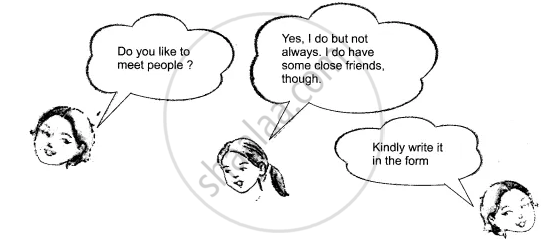
| Questions | Yes/No | Additional Response |
|
1. Do you like to meet people? |
Yes I do, but not always | I do have some close friends, though. |
|
2. Do you like the area you live in? |
No, I Don't | But I have no choice |
Fill in the blanks with the words given in the box.
| how, what, when, where, which |
You don’t know the way to my school. Ask the policeman ______ to get there.
What aspect of shylock's nature is revealed in his words, "To bait fish withal; if it will feed nothing else, it will feed any revenge"?
