Advertisements
Advertisements
प्रश्न
What are advantages of trees for children?
विकल्प
They use trees for furniture.
They get money from trees.
They speak their sorrows to trees.
They can play around trees and get fruits, clothes, books from trees.
Advertisements
उत्तर
They can play around trees and get fruits, clothes, books from trees.
संबंधित प्रश्न
On the basis of your understanding of the poem, answer the following question
by ticking the correct choice.
In the poem 'The Solitary Reaper' to whom does the poet say, ' Stop here or gently
pass'?
Read the comic strip based on. H.G. Wells' novells.


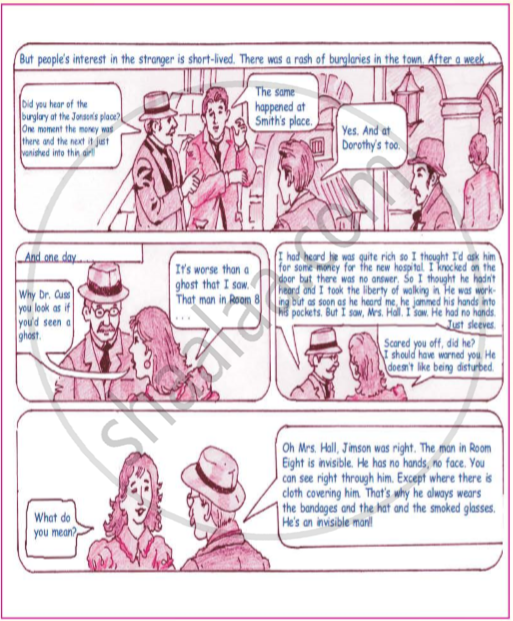
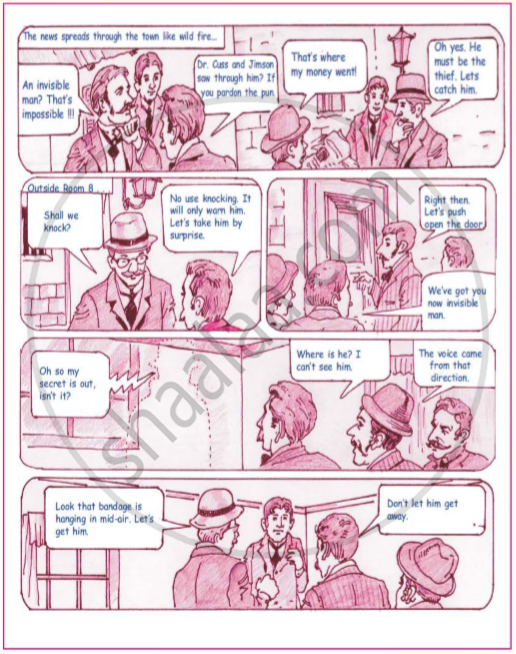
Answer the questions by ticking the correct option.
(a) The strange-looking man wanted ....
(i) the best room at the inn.
(ii} a room with a fire and a good lock.
(iii} a room with a good view.
(iv) a room where he could work quietly.
(b) Jimson was suspicious of the stranger because ...
(i} he did not answer Jimson's questions.
(ii} he did not want to talk about the weather.
(iii} he kept his back turned towards Jimson at all times.
(iv) he shouted atJimson when he entered his room.
(c) The people of the town gossiped about the stranger as ...
(i} he did not go out or talk to anyone in the town.
(ii} he had met with an accident and his face was bandaged.
(iii} he was new to the town and behaved rudely.
(iv) he stayed in his room and did not show his face to anyone.
(d) 'There was a rush of burglaries in the town. This means that ________
(i} there were many robberies in the town.
(ii) a few people in the town had seen a rob her.
(iii} the burglaries in the town were done in a rush.
(iv) the burglar was a rash and careless man.
(e) Although Jimson and Dr Cuss are suspicious of the strange guest, Mrs Hall tolerates him because ....
(i} she is not superstitious or ignorant.
(ii) she is sorry for the stranger who is bandaged.
(iii} the stranger is paying her a good amount of money for the room.
(iv} the stranger is polite and kind to Mrs Hall at all times.
(f) The stranger who was staying at the inn can be described as being ....
(I} violent
(ii} upright
(iii} dishonest
(iv) sensible
Bangle sellers are we who bear
Our shining loads to the temple fair...
Who will buy these delicate, bright
Rainbow-tinted circles of light?
Lustrous tokens of radiant lives,
For happy daughters and happy wives.
Read the lines given above and answer the question that follow.
Who is the speaker in the poem?
"They say it was a shocking sight
After the field was won;
For many thousand bodies here
Lay rotting in the sun;
But things like that, you know, must be
After a famous victory.
"Great praise the Duke of Marlbro'won,
And our good Prince Eugene."
"Why,'twas a very wicked thing!"
Said little Wilhelmine.
"Nay...nay...my little girl,"quoth he,
"It was a famous victory.
"And everybody praised the Duke
Who this great fight did win."
"But what good came of it at last?"
Quoth little Peterkin.
"Why that I cannot tell,"said he,
"But 'twas a famous victory."
Read the lines given above and answer the question that follow.
Explain with reference to context.
The angel wrote and vanished.
The next night, It came again with a great wakening light,
And show's the names whom love of God had blest,
And Lo! Bin Adhem's name led all the rest.
Read the lines given above and answer the following question.
Did the angel appear again?
The angel wrote and vanished.
The next night, It came again with a great wakening light,
And show's the names whom love of God had blest,
And Lo! Bin Adhem's name led all the rest.
Read the lines given above and answer the following question.
Mention two other words used by the poet to refer to the angel.
He looked at me very blankly and tiredly, and then said, having to share his worry with someone, “The cat will be all right, I am sure. There is no need to be unquiet about the cat. But the others. Now what do you think about the others?”
“Why they’ll probably come through it all right.”
“You think so?”
“Why not,” I said, watching the far bank where now there were no carts.
“But what will they do under the artillery when I was told to leave because of the artillery?”
“Did you leave the dove cage unlocked?” I asked.
“Yes.”
“Then they’ll fly.”
“Yes, certainly they’ll fly. But the others. It’s better not to think about the others,” he said.
Read the extract given below and answer the question that follow.
Which animal is the old man least concerned about?
Read the following passage carefully and answer the questions that follow:
Granny knew I'd been in the train for two nights, and she had a huge breakfast ready for me. Later she told me there'd been a letter from Uncle Ken.
'He says he's the manager in Fitpo's hotel in Simla,' she said. 'The salary is very good. It's a steady job and I hope he keeps it.' Three days later Uncle Ken was on the veranda steps with his bedding roll and battered suitcase. 'Have you given up the hotel job?' asked Granny. 'No,' said Uncle Ken. 'They have closed down.' I hope it wasn't because of you.' 'No, Aunt Ellen_ The bigger hotels in the hill stations are closing down. 'Well, never mind. Come along and have your lunch. Over lunch; Uncle Ken talked very seriously about ways and means of earning a living. There is only one taxi in the whole of Debra, he mused. 'Surely there is business for another?' `I'm sure there is,' said Granny. 'But where does it get you? In the first place, you don't have a taxi. And in the second place, you can't drive.' I can soon learn. There's a driving school in town. And I can use Uncle's old car.' 'I don't think it will run now,' said Granny. 'Of course, it will. It just needs some oiling and greasing and a spot of paint.' 'All right, learn to drive.' So, Uncle Ken joined the driving school.After a month Uncle Ken announced that he could drive and that he was taking the car out for a trial run. 'You haven't got your license yet,' said Granny. 'Oh, I won't take it far,' said Uncle Ken. 'Just down the road and back again.' He spent all morning cleaning up the car. Granny gave him money for a can of petrol. After tea, Uncle Ken said, 'Come along, Ruskin, hop in and I will give you a ride. Bring Mohan along too.' Mohan and I needed no urging. We got into the car beside Uncle Ken. 'Now don't go too fast, Ken,' said Granny anxiously. 'You are not used to the car as yet.' Uncle Ken nodded and smiled and gave two sharp toots on the horn. He was feeling pleased with himself. Driving through the gate, he nearly ran over a cat. Miss Kellner, coming out for her evening rickshaw ride, saw Uncle Ken at the wheel of the car and ran indoors again. [40] Uncle Ken drove straight and fast, tootling the horn without a break. At the end of the road there was a roundabout. 'We’ll turn here,' said Uncle Ken, 'and then drive back again.' He turned tt;e steering wheel, we began going round the roundabout, but the steering wheel wouldn't turn all the way, not as much as Uncle Ken would have liked it to... So, instead he went on - and straight through the Maharaja of Jetpur’s garden wall. It was a single-brick wall, and the car knocked it down and emerged on the other, side without any damage to the car or any of its occupants. Uncle Ken brought it to a halt in the middle of the Maharaja's lawn. Running across the grass came the Maharaja himself. When he saw that it was Uncle Ken at the wheel, the Maharaja beamed with pleasure. 'Delighted to see you, old chap!' he exclaimed. 'Jolly decent of you to drop in again. How about a game of tennis?'
(a) Give the meaning of the following words as used in the passage:
One word answers or short phrases will be accepted.
(i) battered
(ii) bused
(iii) emerged
(b) Answer the following questions briefly in your own words.
(i) Why did Granny hope Uncle Ken would keep his job at Fitgo's hotel?
(ii) When Uncle Ken arrived with his luggage, Granny remarked that she hoped the hotel had not closed down because of him. What does this remark tell you about Uncle Ken?
(iii) Why did Uncle Ken think that driving a taxi in Dehra would be profitable?
(iv) Which sentence tells you that the narrator and his friend were waiting to be invited for a drive in a car?
(v) Why did Miss Kellner run indoors when she saw Uncle Ken at the wheel of the car?
(vi) What was Uncle Ken's intention at the roundabout?
(c)
(I) In not more than 60 words, describe what happened after the car went through the wall.
(ii) Give a title to your summary in 3(c)(i). Give a reason to justify choice of the title.
Answer the following question.
Golu’s relatives did not answer his questions because
What was the king’s reaction when he came to know that he had lost the challenge?
Mr Gessler in his last wasn’t in good health. Give three examples to prove this.
We should be friendly towards our neighbours. Why so?
Mr Wonka collected whose toe-nail?
What made the farmer’s wife blind with rage?
Why are snakes dangerous, according to you?
How does the kite look like in the sky?
Answer the following question.
Why was Jumman happy over Algu’s nomination as head Panch?
Look at the following picture. One asks a question, the other answers it. Then the answer is noted in a form as shown below.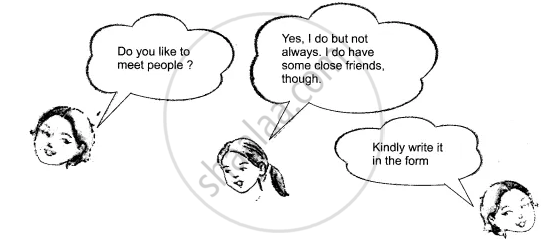
| Questions | Yes/No | Additional Response |
|
1. Do you like to meet people? |
Yes I do, but not always | I do have some close friends, though. |
|
2. Do you like the area you live in? |
No, I Don't | But I have no choice |
Why did the author visit the shop so infrequently?
What does Portia ask of Antonio as a remembrance before she leaves the courtroom?
