Advertisements
Advertisements
प्रश्न
Two straight roads AB and CD cross each other at Pat an angle of 75° . X is a stone on the road AB, 800m from P towards B. BY taking an appropriate scale draw a figure to locate the position of a pole, which is equidistant from P and X, and is also equidistant from the roads.
Advertisements
उत्तर
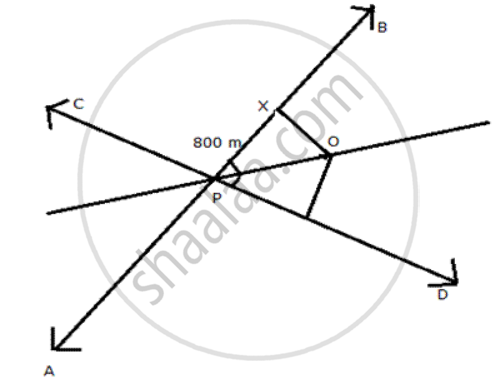
Steps of construction:
(i) Draw two lines AB and CD crossing at an angle of 75 °
(ii) Draw an angle bisector for ∠ BPD
(iii) Draw perpendicular from X on angle bisector meeting at 0.
(iv) From point Y, PX = PY, draw a perpendicular on angle bisector meeting at 0.
(v) 0 is the point which is equidistant from P, X and both the roads.
cos θ = `"hypotenuse"/"base"`
cos `75/2 = "PO"/"PX"`
cos (37.5) = `"PO"/800`
0.980243 = `"PO"/800`
PO = 784.19 m
APPEARS IN
संबंधित प्रश्न
Construct a triangle ABC with AB = 5.5 cm, AC = 6 cm and ∠BAC = 105°
Hence:
1) Construct the locus of points equidistant from BA and BC
2) Construct the locus of points equidistant from B and C.
3) Mark the point which satisfies the above two loci as P. Measure and write the length of PC.
State the locus of a point in a rhombus ABCD, which is equidistant
- from AB and AD;
- from the vertices A and C.
Use graph paper for this question. Take 2 cm = 1 unit on both the axes.
- Plot the points A(1, 1), B(5, 3) and C(2, 7).
- Construct the locus of points equidistant from A and B.
- Construct the locus of points equidistant from AB and AC.
- Locate the point P such that PA = PB and P is equidistant from AB and AC.
- Measure and record the length PA in cm.
Construct a rhombus ABCD with sides of length 5 cm and diagonal AC of length 6 cm. Measure ∠ ABC. Find the point R on AD such that RB = RC. Measure the length of AR.
Draw and describe the locus in the following case:
The locus of a point in the rhombus ABCD which is equidistant from the point A and C.
Use ruler and compass only for the following question. All construction lines and arcs must be clearly shown.
- Construct a ΔABC in which BC = 6.5 cm, ∠ABC = 60°, AB = 5 cm.
- Construct the locus of points at a distance of 3.5 cm from A.
- Construct the locus of points equidistant from AC and BC.
- Mark 2 points X and Y which are at a distance of 3.5 cm from A and also equidistant from AC and BC. Measure XY.
State and draw the locus of a swimmer maintaining the same distance from a lighthouse.
State and draw the locus of a point equidistant from two given parallel lines.
Without using set squares or a protractor, construct:
- Triangle ABC, in which AB = 5.5 cm, BC = 3.2 cm and CA = 4.8 cm.
- Draw the locus of a point which moves so that it is always 2.5 cm from B.
- Draw the locus of a point which moves so that it is equidistant from the sides BC and CA.
- Mark the point of intersection of the loci with the letter P and measure PC.
How will you find a point equidistant from three given points A, B, C which are not in the same straight line?
