Advertisements
Advertisements
प्रश्न
State the direction of incident ray which after reflection from a spherical mirror gets reflected along its own path. Give a reason.
Advertisements
उत्तर

A ray passing through THE CENTRE OF CURVATURE is incident normally on the spherical mirror, gets reflected back along its own path.
A ray passing through the centre of curvature.
It is because the ray is normal to the spherical mirror,
Hence ∠i=0, i.e., the angle of incidence is 0
Therefore, the angle of reflection ∠r=0.
APPEARS IN
संबंधित प्रश्न
A student focused the Sun rays using an optical device 'X' on a screen S as shown.
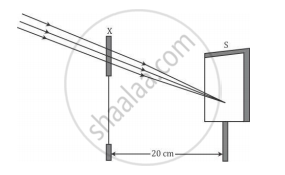
From this it may be concluded that the device 'X' is a (select the correct option)
(A) Convex lens of focal length 10 cm.
(B) Convex lens of radius of curvature 20 cm.
(C) Convex lens of focal length 20 cm.
(D) Concave mirror of focal length 20 cm.
When a spherical mirror is held towards the sun and its sharp image is formed on a piece of a carbon paper for some time, a hole is burnt in the carbon paper.
Why is a hole burnt in the carbon paper?
What is a spherical mirror?
Define the following terms in the context of spherical mirrors :
(i) Pole
(ii) Centre of curvature
(iii) Radius of curvature
(iv) Principal axis
For what position of object, the image formed by a concave mirror is magnified and erect?
State two uses of a concave mirror.
The following figure shows a concave mirror with its pole (P), focus (F), and center of curvature (C). Draw a ray diagram to show the formation of the image of an object AB by the concave mirror.
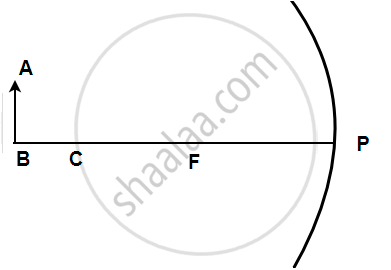
Size of image of an object by a mirror having a focal length of 20 cm is observed to be reduced to 1/3rd of its size. At what distance the object has been placed from the mirror? What is the nature of the image and the mirror?
In normal adjustment, for a refracting telescope, the distance between objective and eye piece is 30 cm. The focal length of the objective, when the angular magnification of the telescope is 2, will be ______.
