Advertisements
Advertisements
प्रश्न
When a spherical mirror is held towards the sun and its sharp image is formed on a piece of a carbon paper for some time, a hole is burnt in the carbon paper.
Why is a hole burnt in the carbon paper?
Advertisements
उत्तर
A concave mirror converges light rays, and in this case it will converge the incoming parallel rays of the sun at its focus. Since the carbon paper was kept at the focus of the concave mirror, the hole was burnt into it.
संबंधित प्रश्न
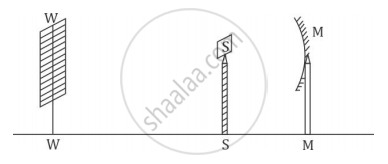
A student obtains a sharp image of the distant window (W) of the school laboratory on the screen (S) using the given concave mirror (M) to determine its focal length. Which of the following distances should he measure to get the focal length of the mirror?
Which type of mirror can form a real image?
Name the spherical mirror which has:
(a) virtual principal focus.
(b) real principal focus.
Name the two types of spherical mirrors. What type of mirror is represented by the:
- back side of a shining steel spoon?
- front side of a shining steel spoon?
When a spherical mirror is held towards the sun and its sharp image is formed on a piece of carbon paper for some time, a hole is burnt in the carbon paper.
- What is the nature of spherical mirror?
- Why is a hole burnt in the carbon paper?
- At which point of the spherical mirror the carbon paper is placed?
- What name is given to the distance between spherical mirror and carbon paper?
- What is the advantage of using a carbon paper rather than a white paper?
The shiny outer surface of a hollow sphere of aluminium of radius 50 cm is to be used as a mirror:
Which type of spherical mirror will it provide?
A diverging lens is used in ______.
In each case (a) and (b), draw reflected rays for the given incident rays and mark focus by the symbol F.
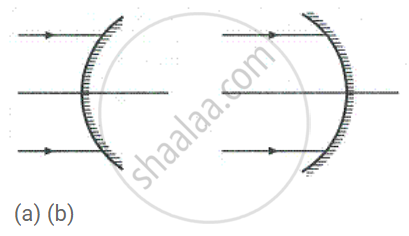
State whether the image in part (a) is real or virtual?
Does the mirror mentioned in part (b) form real image for all locations of the object?
Discuss the position and nature of image formed by a convex mirror when an object is moved from infinity towards the pole of mirror.
How will you distinguish between a plane mirror, a concave mirror and a convex mirror, without touching them?
What is a mirror formula?
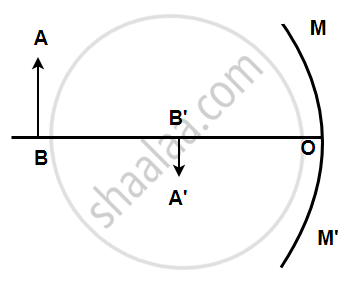
AB is the object, A'B' is the image, and MM' is the position of the mirror. Complete the ray diagram showing the formation of the image and find the focal length of the mirror.
Define the term Pole.
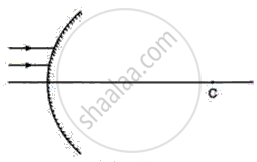
The diagram below shows the parallel rays incident on a convex mirror. C is the centre of the curvature of the mirror. By drawing the paths of the reflected rays, label the focus F and hence find the focal length of the mirror.
Explain why a ray of light passing through the center of curvature of a concave mirror, gets reflected along with the same pattern.
How tall does a mirror have to be to fit an entire person’s body?
