Advertisements
Advertisements
प्रश्न
Prove that the perpendicular drawn from the point (4, 1) on the join of (2, −1) and (6, 5) divides it in the ratio 5 : 8.
Advertisements
उत्तर
Let PD be the perpendicular drawn from P (4, 1) on the line joining the points \[A\left( 2, - 1 \right) \text { and } B\left( 6, 5 \right)\].
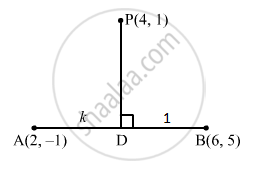
Let m be the slope of PD.
\[\therefore m \times \text { Slope of }AB = - 1\]
\[ \Rightarrow m \times \left( \frac{5 + 1}{6 - 2} \right) = - 1\]
\[ \Rightarrow m \times \frac{6}{4} = - 1\]
\[ \Rightarrow m \times \frac{3}{2} = - 1\]
\[ \Rightarrow m = - \frac{2}{3}\]
Thus, the equation of line PD passing through P (4, 1) and having slope \[- \frac{2}{3}\] is
\[y - 1 = - \frac{2}{3}\left( x - 4 \right)\]
\[ \Rightarrow 3y - 3 = - 2x + 8\]
\[ \Rightarrow 2x + 3y - 11 = 0\]
Let D divide the line AB in the ratio k : 1
Then, the coordinates of D are \[\left( \frac{6k + 2}{k + 1}, \frac{5k - 1}{k + 1} \right)\].
Since, D lies on AB whose equation is \[2x + 3y - 11 = 0\]
Therefore, it satisfy the equation.
\[\therefore 2\left( \frac{6k + 2}{k + 1} \right) + 3\left( \frac{5k - 1}{k + 1} \right) - 11 = 0\]
\[ \Rightarrow 12k + 4 + 15k - 3 - 11k - 11 = 0\]
\[ \Rightarrow 16k = 10\]
\[ \Rightarrow k = \frac{5}{8}\]
Hence, the perpendicular drawn from the point (4, 1) on the line joining the points (2, −1) and (6, 5) divides it in the ratio 5 : 8
APPEARS IN
संबंधित प्रश्न
Find the equation of the line perpendicular to x-axis and having intercept − 2 on x-axis.
Find the equations of the straight lines which pass through (4, 3) and are respectively parallel and perpendicular to the x-axis.
Find the equation of the straight line passing through (−2, 3) and inclined at an angle of 45° with the x-axis.
Find the equation of the line passing through (0, 0) with slope m.
Find the equation of the line passing through \[(2, 2\sqrt{3})\] and inclined with x-axis at an angle of 75°.
Find the equation of the straight line which passes through the point (1,2) and makes such an angle with the positive direction of x-axis whose sine is \[\frac{3}{5}\].
Find the equation of the straight line passing through (3, −2) and making an angle of 60° with the positive direction of y-axis.
Find the equations to the altitudes of the triangle whose angular points are A (2, −2), B (1, 1) and C (−1, 0).
Find the equation of the straight lines passing through the following pair of point:
(a, b) and (a + c sin α, b + c cos α)
Find the equations of the medians of a triangle, the coordinates of whose vertices are (−1, 6), (−3, −9) and (5, −8).
The length L (in centimeters) of a copper rod is a linear function of its celsius temperature C. In an experiment, if L = 124.942 when C = 20 and L = 125.134 when C = 110, express L in terms of C.
Find the equations to the straight lines which go through the origin and trisect the portion of the straight line 3 x + y = 12 which is intercepted between the axes of coordinates.
Find the equation to the straight line cutting off intercepts 3 and 2 from the axes.
Find the equation to the straight line cutting off intercepts − 5 and 6 from the axes.
Find the equation of a line which passes through the point (22, −6) and is such that the intercept of x-axis exceeds the intercept of y-axis by 5.
Find the equation of the straight line passing through the origin and bisecting the portion of the line ax + by + c = 0 intercepted between the coordinate axes.
A straight line drawn through the point A (2, 1) making an angle π/4 with positive x-axis intersects another line x + 2y + 1 = 0 in the point B. Find length AB.
The straight line through P (x1, y1) inclined at an angle θ with the x-axis meets the line ax + by + c = 0 in Q. Find the length of PQ.
If the straight line \[\frac{x}{a} + \frac{y}{b} = 1\] passes through the point of intersection of the lines x + y = 3 and 2x − 3y = 1 and is parallel to x − y − 6 = 0, find a and b.
Find the equation of the line passing through the intersection of the lines 2x + y = 5 and x + 3y + 8 = 0 and parallel to the line 3x + 4y = 7.
Find the equation of a line passing through the point (2, 3) and parallel to the line 3x − 4y + 5 = 0.
Find the length of the perpendicular from the point (4, −7) to the line joining the origin and the point of intersection of the lines 2x − 3y + 14 = 0 and 5x + 4y − 7 = 0.
Find the equations of the straight lines passing through (2, −1) and making an angle of 45° with the line 6x + 5y − 8 = 0.
Find the equations to the straight lines passing through the point (2, 3) and inclined at and angle of 45° to the line 3x + y − 5 = 0.
Find the equations to the sides of an isosceles right angled triangle the equation of whose hypotenues is 3x + 4y = 4 and the opposite vertex is the point (2, 2).
The equation of one side of an equilateral triangle is x − y = 0 and one vertex is \[(2 + \sqrt{3}, 5)\]. Prove that a second side is \[y + (2 - \sqrt{3}) x = 6\] and find the equation of the third side.
Find the equations of two straight lines passing through (1, 2) and making an angle of 60° with the line x + y = 0. Find also the area of the triangle formed by the three lines.
If the diagonals of the quadrilateral formed by the lines l1x + m1y + n1 = 0, l2x + m2y + n2 = 0, l1x + m1y + n1' = 0 and l2x + m2y + n2' = 0 are perpendicular, then write the value of l12 − l22 + m12 − m22.
If a + b + c = 0, then the family of lines 3ax + by + 2c = 0 pass through fixed point
A straight line moves so that the sum of the reciprocals of its intercepts made on axes is constant. Show that the line passes through a fixed point.
The equations of the lines which pass through the point (3, –2) and are inclined at 60° to the line `sqrt(3) x + y` = 1 is ______.
If a, b, c are in A.P., then the straight lines ax + by + c = 0 will always pass through ______.
Equation of the line passing through the point (a cos3θ, a sin3θ) and perpendicular to the line x sec θ + y cosec θ = a is x cos θ – y sin θ = a sin 2θ.
The lines ax + 2y + 1 = 0, bx + 3y + 1 = 0 and cx + 4y + 1 = 0 are concurrent if a, b, c are in G.P.
