Advertisements
Advertisements
प्रश्न
Preparation of ethers by acid dehydration of secondary or tertiary alcohols is not a suitable method. Give reason.
Advertisements
उत्तर १
Acid dehydration of primary alcohols to ethers occurs by SN2 mechanism in which the nucleophilic attack of the alcohol molecule takes place on the protonated alcohol molecule.
\[\ce{CH3CH2CH2\overset{\bullet\bullet}{\underset{\bullet\bullet}{O}}H + CH3CH2CH2 - \overset{+}{\underset{\bullet\bullet}{O}}\overset{+}{H} ->[S_N2][-H+, -H2O] CH3CH2CH2 - O - CH2CH2CH3}\]
Under these conditions, secondary and tertiary alcohols give alkenes instead of ethers. There is no nucleophilic attack of the alcohol molecule on the protonated alcohol molecule. Instead, protonated secondary and tertiary alcohols lose a molecule of water to form stable 2° and 3° carbocations. These carbocations preferentially lose H+ to form alkenes.
\[\begin{array}{cc}
\ce{CH3}\phantom{...........................}\ce{CH3}\phantom{.....................}\ce{CH3}\\\
|\phantom{.................................}|\phantom{...........................}|\phantom{.....}\\
\ce{\underset{\underset{(2^\circ alcohol)}{Propan-2-ol}}{CH3 - CH - OH} ->[H^-] \underset{Protonated 2^\circ alcohol}{CH3 - CH - \overset{+}{O}H2} ->[][-H2O] \underset{2^\circ Carbocation}{CH3 - CH^+}}
\end{array}\]
\[\begin{array}{cc}
\ce{CH3}\phantom{...}\ce{CH3}\phantom{..............................}\ce{CH3}\phantom{...........}\\
|\phantom{.........}|\phantom{....................................}|\phantom{..............}\\
\ce{\underset{2-propoxy-2-propane}{CH3 - CH - O - CH - CH3} ->[CH3CHOCH3][-H^+] CH3 - CH^+ ->[][-H^+] \underset{Propene}{CH3 - CH = CH2}}
\end{array}\]
Similarly, 3° alcohols give alkenes instead of ethers.
\[\ce{\underset{\underset{(3^\circ alcohol)}{2-Methylpropan-2-ol}}{(CH3)3C - OH} ->[H+] \underset{\underset{(3^\circ alcohol)}{Protonated 2-methylpropan-2-ol}}{(CH3)3C - \overset{+}{O}H2} ->[][-H2O] \underset{3^\circ butyl carbocation}{(CH3)3C^+}}\]
\[\begin{array}{cc}
\phantom{.......}\ce{CH3}\phantom{.}\ce{CH3}\phantom{....................................}\ce{CH3}\phantom{..................}\ce{CH3}\\
\phantom{.....}|\phantom{......}|\phantom{..........................................}|\phantom{.........................}|\\
\ce{CH3 - C - O - C - CH3 ->[(CH3)3COH][-H^+] CH3 - C^+ ->[][-H^+] \underset{2-Methylprop-1-ene}{CH3 - CH = CH2}}\\
|\phantom{.......}|\phantom{..........................................}|\phantom{......................}\\
\ce{\underset{2-Methyl-2-(2-methyl-2-propoxy)propane}{\phantom{..}CH3\phantom{..}CH3}}\phantom{...............}\ce{\underset{3^\circ butyl carbocation}{CH3}}\phantom{............................}
\end{array}\]
उत्तर २
Consider the reaction between propan-2-ol molecules in the presence of an acid.
\[\begin{array}{cc}
\phantom{..............}\ce{CH3}\phantom{...........................}\ce{CH3}\\
\phantom{..........}|\phantom{.................................}|\\
\ce{CH3 - CH - OH ->[H+] CH3 - \underset{+}{C}H}\\
\end{array}\]
If an ether is to be formed, another alcohol molecule must carry out a nucleophilic attack on the carbocation as:
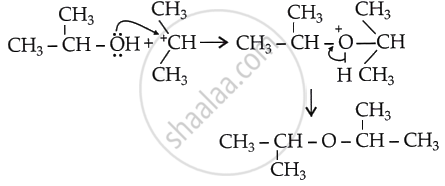
However, this does not happen because of:
- the steric hindrance around the carbocation, and
- the bulky size of the nucleophile would further cause crowding.
As a result, the carbocation prefers to lose a proton, forming an alkene.
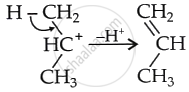
For the same reason, 3° alcohols in the presence of acid do not form ethers since 3° alcohols are even more sterically hindered than 2° alcohols.
APPEARS IN
संबंधित प्रश्न
Explain the mechanism of the following reaction:

Write the equations involved in the following reactions : Williamson synthesis
Write the name of the reagent and the equation for the preparation of the following ether by Williamson’s synthesis:
1-Propoxypropane
Write the name of the reagent and equation for the preparation of the following ethers by Williamson’s synthesis:
1-Methoxyethane
Account for the following :
t-butyl chloride on heating with sodium methoxide gives 2-methylpropene instead of t-butyl methyl ether.
Which of the following compounds gives a secondary alcohol upon reaction with methylmagnesium bromide?
Name the suitable alcohol and reagent, from which 2-Chloro-2-methyl propane can be prepared.
Which of the following reactions are feasible?
Write the mechanism of the following reaction:
\[\ce{2CH3CH2OH ->[H^+][413 K] CH3-CH2-O-CH2-CH3 + H2O}\]
Write the name of reagent and equation for the preparation of the following ethers by Williamson’s synthesis:
2-Methoxy-2-methylpropane
What is metamerism? Give the structure and IUPAC name of metamers of 2-methoxy propane.
Write the name of reagent and equation for the preparation of the following ethers by Williamson’s synthesis:
2-Methoxy-2-methylpropane
Identify the product (s) is/are formed when 1-methoxy propane is heated with excess HI. Name the mechanism involved in the reaction.
Write the name of reagent and equation for the preparation of the following ethers by Williamson’s synthesis:
2-Methoxy-2-methylpropane
Predict the major product, when 2-methyl but -2-ene is converted into an alcohol in the following method.
Acid catalysed hydration
What will be the product (X and A)for the following reaction
\[\ce{acetylchloride->[i)CH3MgBr][ii)H3O+]X ->[acidk2crp3]A}\]
Give the structure and IUPAC name of metamers of 2-methoxy propane
Identify the product (s) is/are formed when 1-methoxy propane is heated with excess HI. Name the mechanism involved in the reaction.
Write the name of reagent and equation for the preparation of the following ether by Williamson’s synthesis:
2-Methoxy-2-methylpropane
