Advertisements
Advertisements
प्रश्न
Explain the following with an example.
Williamson ether synthesis
Advertisements
उत्तर
It is an important laboratory method for preparing symmetrical and unsymmetrical ethers. In this method, an alkyl halide reacts with a sodium alkoxide.
\[\ce{R - X + R' - \overset{\overline{\bullet\bullet}}{\underset{\bullet\bullet}{O}}N\overset{+}{a} -> R - \overset{\bullet\bullet}{\underset{\bullet\bullet}{O}} - R' + NaX}\]
Ethers containing substituted alkyl groups (secondary or tertiary) may also be prepared by this method. The reaction involves an SN2 attack of an alkoxide ion on a primary alkyl halide.

Better results are obtained if the alkyl halide is primary. In the case of secondary and tertiary alkyl halides, elimination competes with substitution. If a tertiary alkyl halide is used, an alkene is the only reaction product, and no ether is formed. For example, the reaction of CH3ONa with (CH3)3C–Br gives exclusively 2-methylpropene.
\[\begin{array}{cc}
\ce{CH3}\phantom{...............................................................................}\\
|\phantom{...................................................................................}\\
\ce{CH3 - C - Br + N\overset{+}{a} \overset{\overline{\bullet\bullet}}{\underset{\bullet\bullet}{O}} - CH3 -> CH3 - C = CH2 + NaBr + CH3OH}\\
|\phantom{.....................................................}|\phantom{..............................}\\
\ce{CH3}\phantom{.........................................}\ce{\underset{2-Methylpropene}{CH3}}\phantom{.....................}\\
\end{array}\]
APPEARS IN
संबंधित प्रश्न
Explain the mechanism of the following reaction:

Write the equations involved in the following reactions : Williamson synthesis
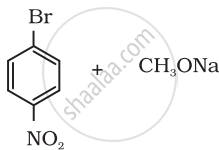
Which of the following is an appropriate set of reactants for the preparation of 1-methoxy-4-nitrobenzene and why?
 |
 |
| (i) | (ii) |
Write the name of the reagent and the equation for the preparation of the following ether by Williamson’s synthesis:
2-Methoxy-2-methylpropane
Write the name of the reagent and equation for the preparation of the following ethers by Williamson’s synthesis:
1-Methoxyethane
Williamson's synthesis of preparing dimethyl ether is a/an ____________.
Which of the following cannot be made by using Williamson Synthesis:
Dehydration of alcohol to ethers is catalysed by:
Name the suitable alcohol and reagent, from which 2-Chloro-2-methyl propane can be prepared.
Write the equations for the following reaction:
Tert butyl chloride is treated with sodium ethoxide.
Write the name of the reagent and equation for the preparation of the following ether by Williamson’s synthesis:
2-Methoxy-2-methylpropane
Write the name of the reagent and equation for the preparation of the following ether by Williamson’s synthesis:
2-Methoxy-2-methylpropane
Write the name of reagent and equation for the preparation of the following ethers by Williamson’s synthesis:
2-Methoxy-2-methylpropane
Short Answer Question.
Identify the product (s) is / are formed when 1 – methoxy propane is heated with excess HI. Name the mechanism involved in the reaction
Write the names of reagents and equations for the preparation of the following ether by Williamson’s synthesis:
2-Methoxy-2-methylpropane
Give the structure and IUPAC name of metamers of 2-methoxy propane
Write the name of reagent and equation for the preparation of the following ethers by Williamson’s synthesis:
2-Methoxy-2-methylpropane
Identify the product (s) is/are formed when 1-methoxy propane is heated with excess HI. Name the mechanism involved in the reaction.
Give the structure and IUPAC name of the metamers of 2-methoxy propane.
