Advertisements
Advertisements
प्रश्न
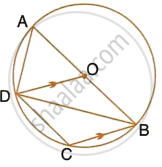
In the given figure, AB is a diameter of the circle with centre O. DO is parallel to CB and ∠DCB = 120°.
Calculate: ∠ADC
Also, show that the ΔAOD is an equilateral triangle.
Advertisements
उत्तर
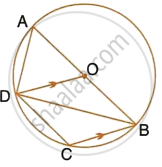
∠ABD + ∠DBC = 30° + 30° = 60°
⇒ ∠ABC = 60°
In cyclic quadrilateral ABCD,
∠ADC + ∠ABC = 180°
(Pair of opposite angles in a cyclic quadrilateral are supplementary)
⇒ ∠ADC = 180° – 60° = 120°
In ∆AOD, OA = OD ...(Radii of the same circle)
∠AOD = ∠DAO Or ∠DAB = 60° ...[Proved in (i)]
∠AOD = 60°
⇒ ∠ADO = ∠AOD = ∠DAO = 60°
∴ ∆AOD is an equilateral triangle.
संबंधित प्रश्न
Prove that the parallelogram, inscribed in a circle, is a rectangle.
Two circles intersect at P and Q. Through P diameters PA and PB of the two circles are drawn. Show that the points A, Q and B are collinear.
In the given figure, PQ is a diameter. Chord SR is parallel to PQ. Given that ∠PQR = 58°,
Calculate:
- ∠RPQ,
- ∠STP.

In the following figure, AD is the diameter of the circle with centre O. Chords AB, BC and CD are equal. If ∠DEF = 110°, calculate: ∠AEF

The following figure shows a circle with PR as its diameter. If PQ = 7 cm and QR = 3RS = 6 cm, find the perimeter of the cyclic quadrilateral PQRS.

In the given figure, AB is the diameter of a circle with centre O.
If chord AC = chord AD, prove that:
- arc BC = arc DB
- AB is bisector of ∠CAD.
Further, if the length of arc AC is twice the length of arc BC, find:
- ∠BAC
- ∠ABC

Using ruler and a compass only construct a semi-circle with diameter BC = 7cm. Locate a point A on the circumference of the semicircle such that A is equidistant from B and C. Complete the cyclic quadrilateral ABCD, such that D is equidistant from AB and BC. Measure ∠ADC and write it down.
In the given figure, AB is a diameter of the circle with centre O. DO is parallel to CB and ∠DCB = 120°.
Calculate : ∠DBA
Also, show that the ΔAOD is an equilateral triangle.
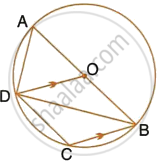
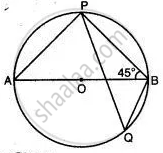
In the given figure, O is the centre of the circle and ∠PBA = 45°. Calculate the value of ∠PQB.
In the figure, ∠DBC = 58°. BD is diameter of the circle.
Calculate:
- ∠BDC
- ∠BEC
- ∠BAC