Advertisements
Advertisements
प्रश्न
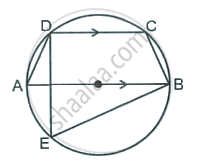
ABCD is a cyclic quadrilateral in which AB is parallel to DC and AB is a diameter of the circle. Given ∠BED = 65°, calculate:
- ∠DAB,
- ∠BDC.
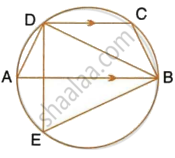
ABCD is a cyclic quadrilateral and DC || AB. If AB is the diameter of the circle and BED = 65°, find:
- ∠DAB
- ∠BDC
Advertisements
उत्तर
(i) Find ∠DAB
Angles BED and DAB are angles subtended by the same chord DB in the same circle.
∴ ∠DAB = ∠BED = 65°
(ii) Find ∠BDC
Since AB is a diameter, angle ADB is an angle in a semicircle:
∠ADB = 90°.
In triangle ABD:
∠ABD = 180° − (∠ADB + ∠DAB)
∠ABD = 180° − (90° + 65°)
∠ABD = 25°.
AB ∥ DC,
∠ABD and ∠BDC are corresponding angles.
∴∠BDC = ∠ABD = 25°.
संबंधित प्रश्न
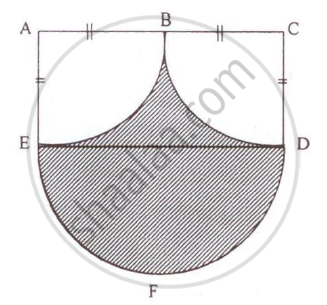
Calculate the area of the shaded region, if the diameter of the semicircle is equal to 14 cm. Take `pi = 22/7`
Prove that the rhombus, inscribed in a circle, is a square.
Two circles intersect at P and Q. Through P diameters PA and PB of the two circles are drawn. Show that the points A, Q and B are collinear.
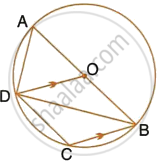
In the given figure, AB is a diameter of the circle with centre O. DO is parallel to CB and ∠DCB = 120°.
Calculate:
- ∠DAB,
- ∠DBA,
- ∠DBC,
- ∠ADC.
Also, show that the ΔAOD is an equilateral triangle.

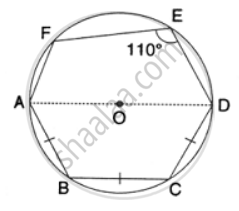
In the following figure, AD is the diameter of the circle with centre O. Chords AB, BC and CD are equal. If ∠DEF = 110°, calculate: ∠AEF

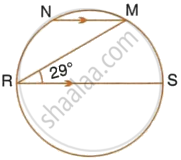
In the given figure, RS is a diameter of the circle. NM is parallel to RS and ∠MRS = 29°. Calculate : ∠NRM
In the given figure, AB is a diameter of the circle with centre O. DO is parallel to CB and ∠DCB = 120°.
Calculate : ∠DBA
Also, show that the ΔAOD is an equilateral triangle.
In the following figure, AD is the diameter of the circle with centre O. chords AB, BC and CD are equal. If ∠DEF = 110°, Calculate: ∠FAB.
In the given figure, BAD = 65°, ABD = 70°, BDC = 45°.
(i) Prove that AC is a diameter of the circle.
(ii) Find ACB.

In the figure given alongside, AD is the diameter of the circle. If ∠ BCD = 130°, Calculate: (i) ∠ DAB (ii) ∠ ADB.

