Advertisements
Advertisements
प्रश्न
Prove that the circle drawn on any one of the equal sides of an isosceles triangle as diameter bisects the base.
Advertisements
उत्तर
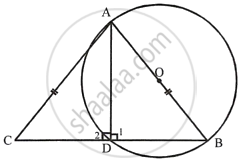
Given – In ∆ABC, AB = AC and a circle with AB as diameter is drawn
Which intersects the side BC and D.
To prove – D is the mid point of BC
Construction – Join AD.
Proof – ∠1 = 90° ...[Angle in a semi circle]
But ∠1 + ∠2 = 180° ...[Linear pair]
∴ ∠2 = 90°
Now in right ∆ABD and ∆ACD,
Hyp. AB = Hyp. AC ...[Given]
Side AD = AD ...[Common]
∴ By the right Angle – Hypotenuse – side criterion of congruence, we have
ΔABD ≅ ∆ACD ...[RHS criterion of congruence]
The corresponding parts of the congruent triangle are congruent.
∴ BD = DC ...[c.p.c.t]
Hence D is the mid point of BC.
संबंधित प्रश्न
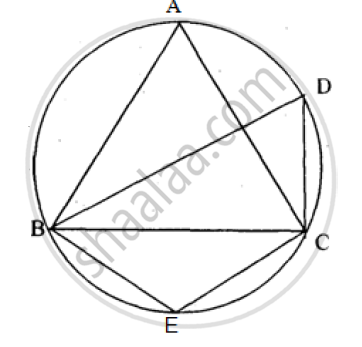
In the figure, m∠DBC = 58°. BD is the diameter of the circle. Calculate:
1) m∠BDC
2) m∠BEC
3) m∠BAC
Prove that the parallelogram, inscribed in a circle, is a rectangle.
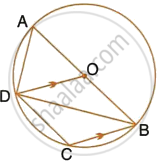
In the figure, given alongside, AB || CD and O is the centre of the circle. If ∠ADC = 25°; find the angle AEB. Give reasons in support of your answer.

In the given figure, AB is a diameter of the circle with centre O. DO is parallel to CB and ∠DCB = 120°.
Calculate:
- ∠DAB,
- ∠DBA,
- ∠DBC,
- ∠ADC.
Also, show that the ΔAOD is an equilateral triangle.

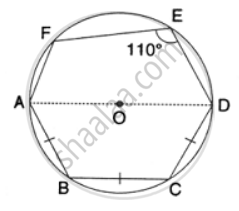
In the following figure, AD is the diameter of the circle with centre O. Chords AB, BC and CD are equal. If ∠DEF = 110°, calculate: ∠AEF

In the figure, given below, AB and CD are two parallel chords and O is the centre. If the radius of the circle is 15 cm, find the distance MN between the two chords of lengths 24 cm and 18 cm respectively.

In the given figure, AB is a diameter of the circle with centre O. DO is parallel to CB and ∠DCB = 120°.
Calculate : ∠DBA
Also, show that the ΔAOD is an equilateral triangle.
In the following figure, AD is the diameter of the circle with centre O. chords AB, BC and CD are equal. If ∠DEF = 110°, Calculate: ∠FAB.
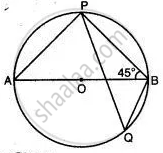
In the given figure, O is the centre of the circle and ∠PBA = 45°. Calculate the value of ∠PQB.
In the given figure, AC is the diameter of the circle with center O.
CD is parallel to BE.
∠AOB = 80° and ∠ACE = 20°
Calculate:
- ∠BEC
- ∠BCD
- ∠CED

