Advertisements
Advertisements
प्रश्न
In the given figure, PQ is a diameter. Chord SR is parallel to PQ. Given that ∠PQR = 58°,
Calculate:
- ∠RPQ,
- ∠STP.

Advertisements
उत्तर
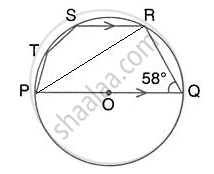
Join PR.
i. ∠PRQ = 90°
(Angle in a semicircle)
∴ In right triangle PQR,
∠RPQ = 90° – ∠PQR
= 90° – 58°
= 32°
ii. Also, SR || PQ
∠PRS = ∠RPQ = 32° (Alternate angles)
In cyclic quadrilateral PRST,
∠STP = 180° – ∠PRS
= 180° – 32°
= 148°
(Pair of opposite angles in a cyclic quadrilateral are supplementary)
APPEARS IN
संबंधित प्रश्न
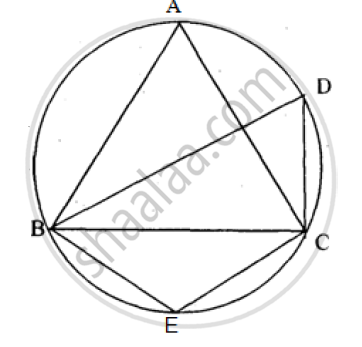
In the figure, m∠DBC = 58°. BD is the diameter of the circle. Calculate:
1) m∠BDC
2) m∠BEC
3) m∠BAC
Prove that the parallelogram, inscribed in a circle, is a rectangle.
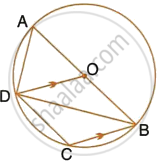
In the given figure, AB is a diameter of the circle with centre O. DO is parallel to CB and ∠DCB = 120°.
Calculate:
- ∠DAB,
- ∠DBA,
- ∠DBC,
- ∠ADC.
Also, show that the ΔAOD is an equilateral triangle.

The following figure shows a circle with PR as its diameter. If PQ = 7 cm and QR = 3RS = 6 cm, find the perimeter of the cyclic quadrilateral PQRS.

Using ruler and a compass only construct a semi-circle with diameter BC = 7cm. Locate a point A on the circumference of the semicircle such that A is equidistant from B and C. Complete the cyclic quadrilateral ABCD, such that D is equidistant from AB and BC. Measure ∠ADC and write it down.
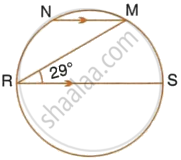
In the given figure, RS is a diameter of the circle. NM is parallel to RS and ∠MRS = 29°. Calculate : ∠NRM
In the given figure, AB is a diameter of the circle with centre O. DO is parallel to CB and ∠DCB = 120°.
Calculate : ∠DBA
Also, show that the ΔAOD is an equilateral triangle.
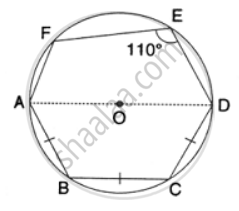
In the following figure, AD is the diameter of the circle with centre O. chords AB, BC and CD are equal. If ∠DEF = 110°, Calculate: ∠FAB.
In the given figure, BAD = 65°, ABD = 70°, BDC = 45°.
(i) Prove that AC is a diameter of the circle.
(ii) Find ACB.

In the given figure, AC is the diameter of the circle with center O.
CD is parallel to BE.
∠AOB = 80° and ∠ACE = 20°
Calculate:
- ∠BEC
- ∠BCD
- ∠CED

