Advertisements
Advertisements
प्रश्न
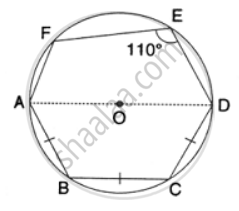
In the following figure, AD is the diameter of the circle with centre O. chords AB, BC and CD are equal. If ∠DEF = 110°, Calculate: ∠FAB.
Advertisements
उत्तर
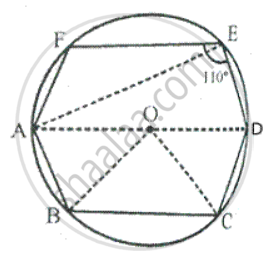
Join AE , OB and OC
∵ Chord AB = Chord BC = Chord CD ...[given]
∴ ∠AOB = ∠BOC = ∠COD ...(Equal chords subtends equal angles at the centre)
But ∠AOB + ∠BOC + ∠COD = 180° ...[AOD is a straight line ]
∠AOB = ∠BOC = ∠COD = 60°
In ∠OAB, OA = OB
∴ ∠OAB = ∠OBA ...[radii of the same circle]
But ∠OAB + ∠OBA = 180° − AOB
= 180° − 60°
= 120°
∴ ∠OAB = ∠OBA = 60°
In cyclic quadrilateral ADEF,
∠DEF + ∠DAF = 180°
⇒ ∠DAF = 180° − ∠DEF
= 180° − 110°
= 70°
Now, ∠FAB = ∠DAF + ∠OAB
= 70° + 60°
= 130°
APPEARS IN
संबंधित प्रश्न
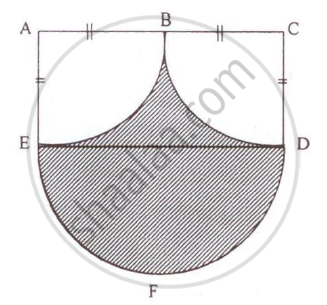
Calculate the area of the shaded region, if the diameter of the semicircle is equal to 14 cm. Take `pi = 22/7`
Prove that the parallelogram, inscribed in a circle, is a rectangle.
In the given figure, AB is a diameter of the circle. Chord ED is parallel to AB and ∠EAB = 63°.
Calculate:
- ∠EBA,
- ∠BCD.

Prove that the circle drawn on any one of the equal sides of an isosceles triangle as diameter bisects the base.
In the figure, given below, AB and CD are two parallel chords and O is the centre. If the radius of the circle is 15 cm, find the distance MN between the two chords of lengths 24 cm and 18 cm respectively.

In the given figure, AB is a diameter of the circle. Chord ED is parallel to AB and ∠EAB = 63°. Calculate : ∠BCD.
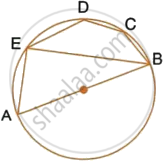
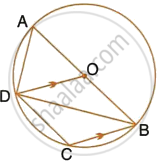
In the given figure, AB is a diameter of the circle with centre O. DO is parallel to CB and ∠DCB = 120°.
Calculate : ∠DBA
Also, show that the ΔAOD is an equilateral triangle.
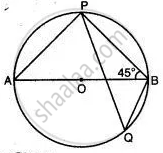
In the given figure, O is the centre of the circle and ∠PBA = 45°. Calculate the value of ∠PQB.
In Fig, Chord ED is parallel to the diameter AC of the circle. Given ∠CBE = 65°, Calculate ∠ DEC.

In the figure given alongside, AD is the diameter of the circle. If ∠ BCD = 130°, Calculate: (i) ∠ DAB (ii) ∠ ADB.

