Advertisements
Advertisements
Question
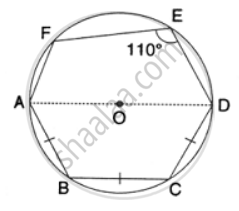
In the following figure, AD is the diameter of the circle with centre O. chords AB, BC and CD are equal. If ∠DEF = 110°, Calculate: ∠FAB.
Advertisements
Solution
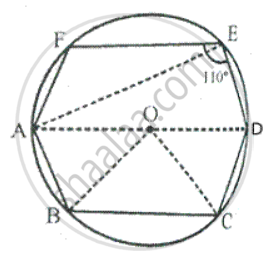
Join AE , OB and OC
∵ Chord AB = Chord BC = Chord CD ...[given]
∴ ∠AOB = ∠BOC = ∠COD ...(Equal chords subtends equal angles at the centre)
But ∠AOB + ∠BOC + ∠COD = 180° ...[AOD is a straight line ]
∠AOB = ∠BOC = ∠COD = 60°
In ∠OAB, OA = OB
∴ ∠OAB = ∠OBA ...[radii of the same circle]
But ∠OAB + ∠OBA = 180° − AOB
= 180° − 60°
= 120°
∴ ∠OAB = ∠OBA = 60°
In cyclic quadrilateral ADEF,
∠DEF + ∠DAF = 180°
⇒ ∠DAF = 180° − ∠DEF
= 180° − 110°
= 70°
Now, ∠FAB = ∠DAF + ∠OAB
= 70° + 60°
= 130°
APPEARS IN
RELATED QUESTIONS
Prove that the rhombus, inscribed in a circle, is a square.
In the given figure, PQ is a diameter. Chord SR is parallel to PQ. Given that ∠PQR = 58°,
Calculate:
- ∠RPQ,
- ∠STP.

Prove that the perimeter of a right triangle is equal to the sum of the diameter of its incircle and twice the diameter of its circumcircle.
In the following figure, AD is the diameter of the circle with centre O. Chords AB, BC and CD are equal. If ∠DEF = 110°, calculate: ∠AEF

Prove that the circle drawn on any one of the equal sides of an isosceles triangle as diameter bisects the base.
The following figure shows a circle with PR as its diameter. If PQ = 7 cm and QR = 3RS = 6 cm, find the perimeter of the cyclic quadrilateral PQRS.

In the figure, given below, AB and CD are two parallel chords and O is the centre. If the radius of the circle is 15 cm, find the distance MN between the two chords of lengths 24 cm and 18 cm respectively.

Using ruler and a compass only construct a semi-circle with diameter BC = 7cm. Locate a point A on the circumference of the semicircle such that A is equidistant from B and C. Complete the cyclic quadrilateral ABCD, such that D is equidistant from AB and BC. Measure ∠ADC and write it down.
In the given figure, BAD = 65°, ABD = 70°, BDC = 45°.
(i) Prove that AC is a diameter of the circle.
(ii) Find ACB.

In the figure given alongside, AD is the diameter of the circle. If ∠ BCD = 130°, Calculate: (i) ∠ DAB (ii) ∠ ADB.

