Advertisements
Advertisements
Question
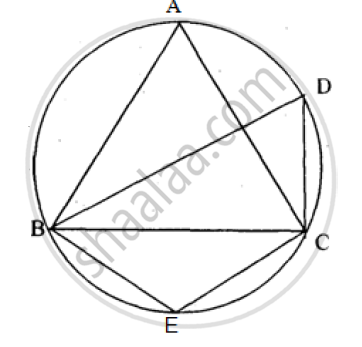
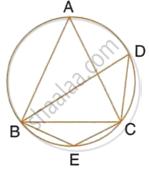
In the figure, m∠DBC = 58°. BD is the diameter of the circle. Calculate:
1) m∠BDC
2) m∠BEC
3) m∠BAC
Advertisements
Solution
1) Given that BD is a diameter of the circle
The angle in a semicircle is a right angle.
∴ ∠BCD = 90°
In ΔBDC, by angle sum property, we have
∠DBC + ∠BCD + ∠BDC = 180°
⇒ 58° + 90° + ∠BDC = 180°
⇒ 148° + ∠BDC = 180°
⇒ ∠BDC = 180° - 148°
⇒ ∠BDC = 32°
2) quadrilateral BECD is a cyclic quadrilateral
⇒ ∠BEC + ∠BCD = 180° (Opposite angles are supplementary)
⇒ ∠BEC + 32° = 180°
⇒ ∠BEC = 148°
3) Angles in the same segment are equal.
⇒ ∠BAC = ∠BDC = 32°
APPEARS IN
RELATED QUESTIONS
Prove that the rhombus, inscribed in a circle, is a square.
Two circles intersect at P and Q. Through P diameters PA and PB of the two circles are drawn. Show that the points A, Q and B are collinear.
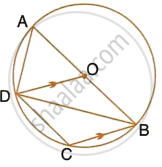
In the given figure, AB is a diameter of the circle with centre O. DO is parallel to CB and ∠DCB = 120°.
Calculate:
- ∠DAB,
- ∠DBA,
- ∠DBC,
- ∠ADC.
Also, show that the ΔAOD is an equilateral triangle.

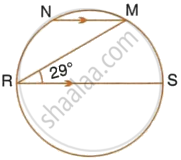
In the given figure, RS is a diameter of the circle. NM is parallel to RS and ∠MRS = 29°. Calculate : ∠NRM
In the given figure, AB is a diameter of the circle with centre O. DO is parallel to CB and ∠DCB = 120°.
Calculate : ∠DBC
Also, show that the ΔAOD is an equilateral triangle.

In the given figure, AB is a diameter of the circle with centre O. DO is parallel to CB and ∠DCB = 120°.
Calculate: ∠ADC
Also, show that the ΔAOD is an equilateral triangle.
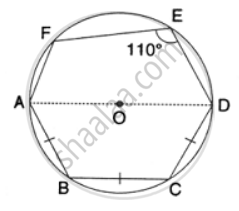
In the following figure, AD is the diameter of the circle with centre O. chords AB, BC and CD are equal. If ∠DEF = 110°, Calculate: ∠FAB.
In the given figure, BAD = 65°, ABD = 70°, BDC = 45°.
(i) Prove that AC is a diameter of the circle.
(ii) Find ACB.

In the figure, ∠DBC = 58°. BD is diameter of the circle.
Calculate:
- ∠BDC
- ∠BEC
- ∠BAC
In the given figure, AC is the diameter of the circle with center O.
CD is parallel to BE.
∠AOB = 80° and ∠ACE = 20°
Calculate:
- ∠BEC
- ∠BCD
- ∠CED

