Advertisements
Advertisements
प्रश्न
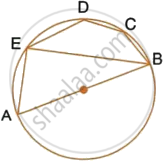
In the given figure, AB is a diameter of the circle. Chord ED is parallel to AB and ∠EAB = 63°. Calculate : ∠BCD.
Advertisements
उत्तर

AB || ED
Therefore ∠DEB = EBA = 27° (Alternate angles)
Therefore BCDE is a cyclic quadrilateral
Therefore ∠DEB + ∠BCD = 180°
[Pair of opposite angles in a cyclic quadrilateral are supplementary]
Therefore ∠BCD = 180° – 27° = 153°
संबंधित प्रश्न
ABC is a right angles triangle with AB = 12 cm and AC = 13 cm. A circle, with centre O, has been inscribed inside the triangle.
Calculate the value of x, the radius of the inscribed circle.

Prove that the rhombus, inscribed in a circle, is a square.
In the given figure, RS is a diameter of the circle. NM is parallel to RS and ∠MRS = 29°. Calculate : ∠RNM

In the figure, given alongside, AB || CD and O is the centre of the circle. If ∠ADC = 25°; find the angle AEB. Give reasons in support of your answer.

In the given figure, AB is a diameter of the circle. Chord ED is parallel to AB and ∠EAB = 63°.
Calculate:
- ∠EBA,
- ∠BCD.

In the given figure, PQ is a diameter. Chord SR is parallel to PQ. Given that ∠PQR = 58°,
Calculate:
- ∠RPQ,
- ∠STP.

Prove that the circle drawn on any one of the equal sides of an isosceles triangle as diameter bisects the base.
In the given figure, AB is a diameter of the circle with centre O. DO is parallel to CB and ∠DCB = 120°.
Calculate : ∠DBC
Also, show that the ΔAOD is an equilateral triangle.

In the given figure, BAD = 65°, ABD = 70°, BDC = 45°.
(i) Prove that AC is a diameter of the circle.
(ii) Find ACB.

In the given figure, AC is the diameter of the circle with center O.
CD is parallel to BE.
∠AOB = 80° and ∠ACE = 20°
Calculate:
- ∠BEC
- ∠BCD
- ∠CED

