Advertisements
Advertisements
प्रश्न
Advertisements
उत्तर
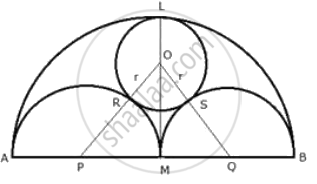
Let O, P and Q be the centers of the circle and semicircle.
Join OP and OQ.
OR = OS = r
And `AP = PM = MQ = QB = (AB)/4`
Now, `OP = OR + RP = r + (AB)/4` ...(Since PM = RP = radii of same circle)
Similarly, `OQ = OS + SQ = r + (AB)/4`
`OM = LM - OL = (AB)/2 - r`
Now in right ΔOPM,
OP2 = PM2 + OM2
`=> (r + (AB)/4)^2 = ((AB)/4)^2 + ((AB)/2 - r)^2`
`=> r^2 + (AB^2)/16 + (rAB)/2 = (AB^2)/16 + (AB^2)/4 + r^2 - rAB`
`=> (rAB)/2 = (AB^2)/4 - rAB`
`=> (AB^2)/4 = (rAB)/2 + rAB`
`=> (AB^2)/4 = (3rAB)/2`
`=> (AB)/4 = 3/2 r`
`=> AB = 3/2 rxx 4 = 6r`
Hence AB = 6 × r
संबंधित प्रश्न
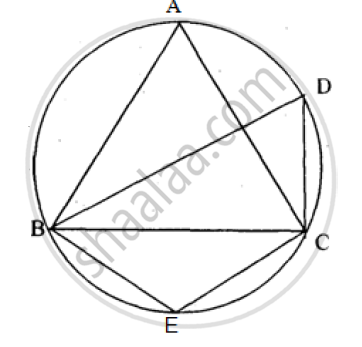
In the figure, m∠DBC = 58°. BD is the diameter of the circle. Calculate:
1) m∠BDC
2) m∠BEC
3) m∠BAC
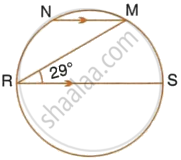
In the given figure, RS is a diameter of the circle. NM is parallel to RS and ∠MRS = 29°. Calculate : ∠RNM

ABCD is a cyclic quadrilateral in which AB is parallel to DC and AB is a diameter of the circle. Given ∠BED = 65°, calculate:
- ∠DAB,
- ∠BDC.
In the given figure, PQ is a diameter. Chord SR is parallel to PQ. Given that ∠PQR = 58°,
Calculate:
- ∠RPQ,
- ∠STP.

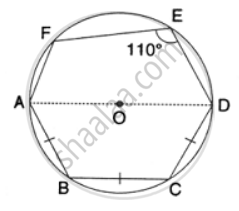
In the following figure, AD is the diameter of the circle with centre O. Chords AB, BC and CD are equal. If ∠DEF = 110°, calculate: ∠AEF

The following figure shows a circle with PR as its diameter. If PQ = 7 cm and QR = 3RS = 6 cm, find the perimeter of the cyclic quadrilateral PQRS.

In the given figure, RS is a diameter of the circle. NM is parallel to RS and ∠MRS = 29°. Calculate : ∠NRM
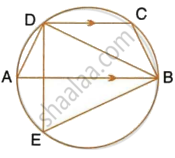
In the given figure, AB is a diameter of the circle. Chord ED is parallel to AB and ∠EAB = 63°. Calculate : ∠BCD.
In the following figure, AD is the diameter of the circle with centre O. chords AB, BC and CD are equal. If ∠DEF = 110°, Calculate: ∠FAB.
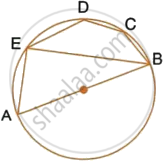
In the given figure, BAD = 65°, ABD = 70°, BDC = 45°.
(i) Prove that AC is a diameter of the circle.
(ii) Find ACB.

