Advertisements
Advertisements
प्रश्न
How does the β-galactosidase coding sequence act as a selectable marker? Why is it a preferred selectable marker to antibiotic resistance genes? Explain.
Advertisements
उत्तर
Selective marker is used in the selection of recombinants on the basis of the ability to produce color in the presence of chromogenic substrate. β-galactosidase is an enzyme that converts galactose into lactose. In this, a recombinant DNA is inserted within the coding sequence of enzyme, β-galactosidase, which results in inactivation of an enzyme referred to as "insertional inactivation". As a result of this, non-recombinants will produce blue-colored colonies while the recombinants will produce color-less colonies.
The coding sequence for the enzyme β-galactosidase is preferred over antibiotic resistance genes because recombinants can be easily visualized and the process is less cumbersome.
APPEARS IN
संबंधित प्रश्न
Draw a schematic sketch of pBR 322 plasmid and label the following in it:
(a) Any two restriction sites.
(b) Ori and rop genes.
(c) An antibiotic resistant gene.
Why is the coding sequence of an enzyme β-galactosidase a preferred selectable marker in comparison to the ones named above?
Which of the following is correctly matched?
A suitable vector for gene cloning in higher organism is ______.
A cloning vector should possess which of the following characters?
- Origin of replication (Ori)
- Ability to destroy the alien DNA
- Cloning site to link the alien DNA
- The tumour inducing plasmid Ti.
- Selectable marker.
- Low molecular weight
The CORRECT combination is
Describe the role of CaCl2 in the preparation of competent cells?
Name the regions marked A, B and C.

Describe the role of Agrobacterium tumefaciens in transforming a plant cell.
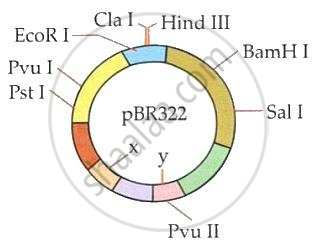
The following diagram showing restriction sites in E. coli cloning vector pBR322. Find the role of ‘X’ and ‘Y’ genes:
Which of the following serves as an example of selectable markers commonly found in plasmid vectors like pBR322?
