Advertisements
Advertisements
प्रश्न
Have you seen animals or birds making houses in trees?
Advertisements
उत्तर
Yes, I have seen many animals making their houses, nests in trees. Female monkeys joyously sit on the branches, pluck peas, beans etc take out the nuts and feed their young ones. They feel a great content in doing so.
संबंधित प्रश्न
Tick the right answer.
When something is considered auspicious, (welcome it/avoid it).
Take down the following scrambled version of a story, that your teacher will dictate to
you, with appropriate punctuation marks. Then, read the scrambled story carefully and try to rewrite it rearranging the incidents. A grasshopper, who was very hungry, saw her and said, “When did you get the corn? I am dying of hunger.” She wanted to dry them. It was a cold winter’s day, and an ant was bringing out some grains of corn from her home. She had gathered the corn in summer. “I was singing all day,” answered the grasshopper.
“If you sang all summer,” said the ant, “you can dance all winter.”
“What were you doing?” asked the ant again.
The grasshopper replied, “I was too busy.”
“I collected it in summer,” said the ant. “What were you doing in summer? Why did you not store some corn?”
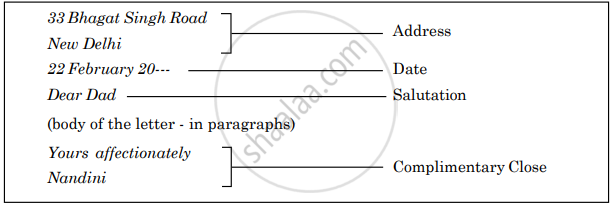
When we write informal letters (to a friend, or to a member of our family), we use this layout.
It was my business to cross the bridge, explore the bridge head 3 beyond and find out to what point the enemy had advanced. I did this and returned over the bridge. There were not so many carts now and very few people on foot, but the old man was still there.’’Where do you come from?” I asked him.
“From San Carlos,” he said, and smiled.
That was his native town and so it gave him pleasure to mention it and he smiled.
“I was taking care of animals,” he explained.
“Oh,” I said, not quite understanding.
“Yes,” he said, “I stayed, you see, taking care of animals. I was the last one to leave the town of San Carlos.”
He did not look like a shepherd nor a herdsman and I looked at his black dusty clothes and his gray dusty face and his steel rimmed spectacles and said, “What animals were they?”
“Various animals,” he said, and shook his head. “I had to leave them.”
Read the extract given below and answer the question that follow.
What is the narrator’s job?
He flungs himself down in a corner to recoup from the fatigue of his visit to the shop. His wife said, “You are getting no sauce today, nor anything else. I can’t find anything to give you to eat. Fast till the evening, it’ll do you good. Take the goats and be gone now,” she cried and added, “Don’t come back before the sun is down.”
Read the extract given below and answer the question that follow.
Did The shopkeeper give Muni what he needed? Why/ Why not?
The horse was nearly life-size, moulded out of clay, baked, burnt, and brightly coloured, and reared its head proudly, prancing its forelegs in the air and flourishing its tail in a loop; beside the horse stood a warrior with scythelike mustachios, bulging eyes, and aquiline nose. The old image-makers believed in indicating a man of strength by bulging out his eyes and sharpening his moustache tips, and also decorated the man’s chest with beads which looked today like blobs of mud through the ravages of sun and wind and rain (when it came), but Muni would insist that he had known the beads to sparkle like the nine gems at one time in his life.
Read the extract given below and answer the question that follow.
Describe the horse.
The village consisted of less than thirty houses, only one of them built with brick and cement. Painted a brilliant yellow and blue all over with gorgeous carvings of gods and gargoyles on its balustrade, it was known as the Big House. The other houses, distributed in four streets, were generally of bamboo thatch, straw, mud, and other unspecified material. Muni’s was the last house in the fourth street, beyond which stretched the fields. In his prosperous days Muni had owned a flock of forty sheep and goats and sallied forth every morning driving the flock to the highway a couple of miles away.
Read the extract given below and answer the question that follow.
Describe the Big House.
As it turned out, Luz broke his own past record. In doing so, he pushed me on to a peak performance. I remember that at the instant I landed from my final jump—the one which set the Olympic record of 26 feet 5-5/16 inches—he was at my side, congratulating me. Despite the fact that Hitler glared at us from the stands not a hundred yards away, Luz shook my hand hard—and it wasn’t a fake “smile with a broken heart” sort of grip, either.
You can melt down all the gold medals and cups I have, and they couldn’t be a plating on the 24-carat friendship I felt for Luz Long at that moment. I realized then, too, that Luz was the epitome of what Pierre de Coubertin, founder of the modern Olympic Games, must have had in mind when he said, “The important thing in the Olympic Games is not winning but taking part. The essential thing in life is not conquering but fighting well.”
Read the extract given below and answer the question that follow.
You can melt down all the gold medals and cups I have, and they wouldn’t be a plating on the 24-carat friendship I felt for Luz Long at that moment.
When Mabel Dancy later requests De Levis to withdraw the charge, how does he respond? What declaration does Dancy wish De Levis to sign?
(i) The man insisted on buying the doves because he was fond of birds. Do you agree?
(ii) How had he earned the five dollars he had?
The king forgave the bearded man. What did he do to show his forgiveness?
The following sentence has two blanks. Fill in the blanks with appropriate forms of the word given in brackets.
Asking for_________ is as noble as willingness to________ . (forgive)
Mridu had noticed in front of Meena’s house a pair of chappals. Whom did they belong to?
Who really helped Vijay Singh in defeating the ghost? How?
Mark the right item:
“This, said the emperor, was to encourage all children to honour and obey their parents.”
‘This’ refers to ______
Read the following sets of words loudly and clearly.
cot – coat
cost – coast
tossed – toast
got – goat
rot – rote
blot – bloat
knot – note
Play detectives with each other. Find a person in your class (or some other acquaintance) to speak to. Find out the answers to the questions given below. Be careful to ask your questions in a polite and inoffensive way. Do not force the person to answer you. Then allow the person to ask you the same questions.
- Name?
- What newspapers or magazines does the person read?
- How long has the person lived at the current address?
- What does she/he do during the day, i.e. the daily routine?
- What do neighbours and friends say about the person?
- Who are his/her visitors and what are his/her eating habits? (You can ask a few others about this.)
- What do you think about the person?
Read the extract given below and answer the questions that follow:
| An angry athlete is an athlete who will make mistakes, as any coach will tell you. I was no exception. On the first of my three qualifying jumps, I leaped from several inches beyond the take-off board for a foul. |
- When and where is this narrative set? [2]
- What reason does the narrator Jesse Owens give for the heightened nationalistic feelings at this time? [2]
- In which event had Owens been confident of winning a gold medal? Why? [3]
- What had made Owens angry enough to make mistakes? Name Owens’ rival who approached him at this point. [3]
When Antony says, ‘This is a slight unmeritable man/Meet to be sent on errands’, he refers to ______.
Complete the following sentence by providing a reason.
Beethoven amputated the legs of his piano because ______.
