Advertisements
Advertisements
प्रश्न
Give any four reasons why water is necessary in our body.
Advertisements
उत्तर
Importance of water in our body:
- Water is the major component of blood, which carries nutrients and oxygen, to and from all the cells.
- It is the major component of saliva and mucous, which lubricate the membranes that line our digestive system beginning with the mouth.
- It helps in regulating the temperature of the body.
- Water is very essential for digestion as well as absorption of food.
APPEARS IN
संबंधित प्रश्न
Fill in the blank and rewrite the completed statement:
.................... is the largest gland in the body.
Write names of different parts of human digestive system and explain functions of any three parts.
Name the enzyme present in human saliva. What type of food material is digested by this enzyme?
Name the following:
An enzyme secreted by gastric glands in stomach which acts on proteins.
Which of the following component of our food is digested by an enzyme which is present in saliva as well as in pancreatic juice?
What is the dental formula of a normal human adult?
What is roughage? Give two examples.
Study the diagram given below and then answer the question that follows:
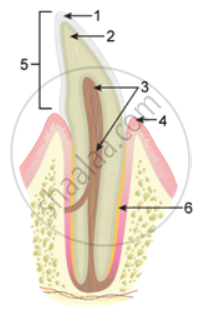
Give the total number of the type of tooth mentioned in '1' above, in the mouth of an adult and state its function.
Write the function of the following in the human alimentary canal:
HCl in stomach
State whether the following statement is True or False.
Wisdom tooth appears at the age of 5-6 years when the child starts going to school.
Find the odd one out. Give reasons for your choice
Describe the following: Digestion of fat in the intestine
Who is telling a lie?
Liver: I am the largest gland in the body.
Answer the following question.
Small Intestine is very long and coiled. Even if we jump and run, why it does not get twisted? What can happen if it gets twisted?
Write down the explanation.
Explain the structure of tooth.
Bile helps in the digestion of ______.
Identify the salivary gland lying below the tongue.
The process of digestion is completed by:
Liver transports nutrients, oxygen, wastes, and hormones.
Digestion of food starts in ______ and gets completed in ______.
