Advertisements
Advertisements
प्रश्न
Write down the explanation.
Explain the structure of tooth.
Advertisements
उत्तर
Structure of tooth:
Tooth Anatomy
- A tooth consists of the portion that projects above the gum called crown and the root that is made up of two or three projections which are embedded in gum.
- A short neck connects the crown with the root.
- The crown is covered by the hardest substance of the body called enamel, which is made up of calcium phosphate and calcium carbonate.
- Basic shape of tooth is derived from dentin which is a calcified connective tissue.
- The dentin encloses the pulp cavity. It is filled with connective tissue pulp. It contains blood vessels and nerves.
- Pulp cavity has extension in the root of the tooth called root canal.
- The dentin of the root of tooth is covered by cementum, which is a bone like substance that attaches the root to the surrounding socket in the gum.
- We have four different types of teeth hence, we are heterodont. Types of teeth are incisors (I), canines (C), premolars (PM) and molars (M). Each half of each jaw has two incisors, one canine, two premolars and three molars.
- Thus, the dental formula of adult human can be represented as.
`I2/2, C1/1, PM2/2, M3/3 = (2, 1, 2, 3)/(2, 1, 2, 3)`
i.e. 8 × 2 = 16 teeth in each jaw = 32 teeths
APPEARS IN
संबंधित प्रश्न
Digestion of starch starts in the stomach.
Where is the bile produced? Which component of the food does it help to digest?
Match the items of Column I with suitable items in Column II.
| Column I | Column II | ||
| (a) | Salivary gland | (i) | Bile juice secretion |
| (b) | Stomach | (ii) | Storage of undigested food |
| (c) | Liver | (iii) | Saliva secretion |
| (d) | Rectum | (iv) | Acid release |
| (e) | Small intestine | (v) | Digestion is completed |
| (f) | Large intestine | (vi) | Absorption of water |
| (vii) | Release of faeces |
What is the special name of the contraction and expansion movement which pushes the food further in our digestive tract (or alimentary canal)?
What harm can dental plaque do?
| If the teeth are not cleaned regularly, they become covered with a sticky yellowish layer W of food particles and bacteria. Since layer W covers the teeth, the alkaline liquid X secreted by glands Y inside the mouth cannot reach the teeth surface to neutralise the acid formed by the action of organisms Z on sugary food, and hence tooth decay sets in. |
- What is W known as?
- What are (i) X and (ii) Y?
- What are organisms Z?
- State one way of removing layer W from the teeth.
Where does digestion of fat take place in our body?
What is the dental formula of a normal human adult?
What are the main characteristics of enzyme?
The teeth called canines are a total of four in number on the sides of ______.
Fill in the blank.
The teeth called ______ are a total of four in number on the sides of incisors
State whether the following statement is True or False.
Wisdom tooth appears at the age of 5-6 years when the child starts going to school.
Define the term nutrition.
Write true or false for the below statement. Rewrite the false statements correctly.
Saliva contains lipase which digests carbohydrates
Write true or false for the below statement. Rewrite the false statements correctly.
All the absorbed nutrients are immediately required by the body.
State one difference in nutrition: Holozoic and Saprozoic nutrition
Describe the following: Digestion of fat in the intestine
Match items in column A with the appropriate items in Column B:
| Column A | Column B | ||
| 1 | HCl | a | Lactose |
| 2 | Rennin | b | Pellagra |
| 3 | Enteropeptidase | c | Rumen |
| 4 | Cellulose | d | Pepsin |
| 5 | Ptyalin | e | Starch |
| 6 | Vitamin | f | Pernicious anaemia |
| 7 | Intestinal juice | g | Trypsin |
| 8 | Bile salt | h | Casein |
| 9 | Vitamin A | i | Micelle |
| 10 | Goitre | j | Night-blindness |
| k | Iodine | ||
Correct the spellings: HLC
The question has four options. Choose the correct answer:
Stomach in vertebrates is the chief site of digestion of
The question has four options. Choose the correct answer:
The hardest constituent of the tooth is
The process of digestion starts from the ______.
How do we know that we are hungry and that we should now eat?
State whether true or false. If false, correct the statement.
During digestion, proteins are broken down into amino acids.
Observe the diagram of Human digestive system.
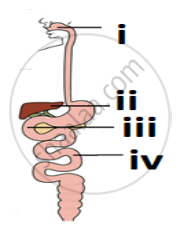
Match the labeling referred in column I and correlate with the function in column II.
| Column I | Column II | |
| i. | a. | The length of this depends on food the organism eats. |
| ii. | b. | Initial phase of starch digestion |
| iii. | c. | Increase the efficiency of lipase enzyme action |
| iv. | d. | This is the site of the complete digestion of carbohydrates, proteins and fats. |
Salivary glands secrete ______.
List the glands associated with digestion.
In which of the following groups of organisms, food material is broken down outside the body and absorbed?
What are the functions of gastric glands present in the wall of the stomach?
In which layer of the wall of alimentary canal, secretary glands are present?
