Advertisements
Advertisements
प्रश्न
Digestion of starch starts in the stomach.
विकल्प
True
False
Advertisements
उत्तर
This statement is False.
Explanation:
Digestion starts in the mouth. The enzyme amylase in saliva begins breaking down starch into simpler sugars before the food reaches the stomach.
APPEARS IN
संबंधित प्रश्न
The gall bladder temporarily stores bile.
Carbohydrates are bodybuilding nutrients.
Iodine turns blue-black on reacting with ______.
The process of digestion in humans is completed in ______.
Where are proteins first digested in the alimentary canal?
Name the following
The organ where protein digestion-begins
Define the term nutrition.
Define the following term:
Digestion
Differentiate between
Digestion and Absorption
Define with examples: Herbivores
State whether the following statements are True or false: Trypsin coagulates the milk protein.
The question has four options. Choose the correct answer:
The amount of saliva produced per day in human is
The question has four options. Choose the correct answer:
Common passage for swallowing food and breathing is
Who is telling a lie?
Appendix: Digestion is impossible without me.
In the given histology of the alimentary canal, identify i, ii, and iii.
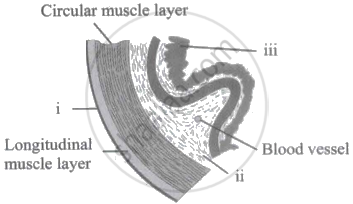
Liver transports nutrients, oxygen, wastes, and hormones.
Write the chemical name and Molecular formula of tooth enamel.
In human beings, when the process of digestion is completed, the (i) proteins, (ii) carbohydrates and (iii) fats are respectively finally converted into ______.
Mucosa forms __a__ in stomach and ___b___ in intestine respectively.
