Advertisements
Advertisements
प्रश्न
For the reaction:
\[\ce{2A + B -> A2B}\]
the rate = k[A][B]2 with k = 2.0 × 10⁻⁶ mol−2 L2 s−1. Calculate the initial rate of the reaction when [A] = 0.1 mol L−1, [B] = 0.2 mol L−1. Calculate the rate of reaction after [A] is reduced to 0.06 mol L−1.
Advertisements
उत्तर
Given: [A] = 0.1 mol L−1
[B] = 0.2 mol L−1
k = 2.0 × 10⁻⁶
The initial rate of the reaction is
Rate = k[A][B]2
= 2.0 × 10−6 × 0.1 × (0.2)2
= 8 × 10⁻⁹ mol L−1 s−1
When [A] reduces to 0.06 mol L−1, i.e. 0.04 mol L−1 of A has reacted, then the reactant B
= `1/2 xx 0.04`
= 0.02 mol L−1
Hence, the new [B] = 0.2 − 0.02 = 0.18 mol L−1
Thus, the new concentrations of A and B are
[A] = 0.06 mol L−1,
[B] = 0.18 mol L−1,
Now rate = 2.0 × 10−6 × (0.06) × (0.18)2
= 3.89 × 10⁻⁹ mol L−1 s−1
APPEARS IN
संबंधित प्रश्न
A → B is a first order reaction with rate 6.6 × 10⁻⁵m-s-1. When [A] is 0.6m, rate constant of the reaction is
- 1.1 × 10⁻⁵s-1
- 1.1 × 10⁻⁴s-1
- 9 × 10⁻⁵s-1
- 9 × 10⁻⁴s-1
Write molecularity of the following reaction:
2NO(g)+O2(g)→2NO2(g)
For a reaction: 
Rate = k
(i) Write the order and molecularity of this reaction.
(ii) Write the unit of k.
For a reaction A + B ⟶ P, the rate is given by
Rate = k [A] [B]2
How is the rate of reaction affected if the concentration of B is doubled?
For a reaction A + B ⟶ P, the rate is given by
Rate = k [A] [B]2
What is the overall order of reaction if A is present in large excess?
From the rate expression for the following reaction, determine the order of reaction and the dimension of the rate constant.
\[\ce{3NO_{(g)} -> N2O_{(g)}}\] Rate = k[NO]2
A reaction is first order in A and second order in B. How is the rate affected on increasing the concentration of B three times?
Rate of reaction for the combustion of propane is equal to:
\[\ce{C3H8_{(g)} + 5O2_{(g)} -> 3CO2_{(g)} + 4H2O_{(g)}}\]
The value of rate constant of a pseudo first order reaction ______.
In any unimolecular reaction:
(i) only one reacting species is involved in the rate determining step.
(ii) the order and the molecularity of slowest step are equal to one.
(iii) the molecularity of the reaction is one and order is zero.
(iv) both molecularity and order of the reaction are one.
For which type of reactions, order and molecularity have the same value?
Match the graph given in Column I with the order of reaction given in Column II. More than one item in Column I may link to the same item of Column II.
| Column I | Column II | |
| (i) | 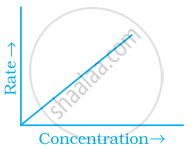 |
|
| (ii) | 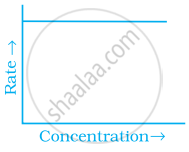 |
(a) 1st order |
| (iii) | 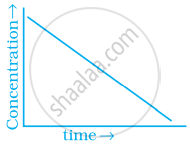 |
(b) Zero-order |
| (iv) | 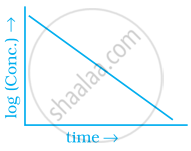 |
Assertion: Order and molecularity are same.
Reason: Order is determined experimentally and molecularity is the sum of the stoichiometric coefficient of rate determining elementary step.
In the presence of a catalyst, the heat evolved or absorbed during the reaction.
The rate of a chemical reaction double for every 10° rise in temperature. If the temperature is raised. by 50°C, the rate of relation by about:-
For a reaction 1/2 A ⇒ 2B, rate of disappearance of A is related 't o the appearance of B by the expression:
Identify the order of reaction from the following unit for its rate constant:
L mol–1 s–1
Assertion (A): Order of reaction is applicable to elementary as well as complex reactions.
Reason (R): For a complex reaction, molecularity has no meaning.
A reaction is second order with respect to a reactant. How is the rate of reaction affected if the concentration of the reactant is reduced to half?
