Advertisements
Advertisements
प्रश्न
The value of rate constant of a pseudo first order reaction ______.
विकल्प
depends on the concentration of reactants present in small amount.
depends on the concentration of reactants present in excess.
is independent of the concentration of reactants.
depends only on temperature.
Advertisements
उत्तर
The value of rate constant of a pseudo first order reaction depends on the concentration of reactants present in excess.
Explanation:
Let's start with what a pseudo-first-order response is.
Although the pseudo-first-order reaction looks to be an order, it belong to another order. it's a second-order reaction because it involves two reactants.
Let's have a look at a reaction.
\[\ce{CH3Br + OH -> CH3OH + Br}\]
So, the rate law for the reaction is
Rate = \[\ce{k[OH][CH3Br]}\]
Rate = \[\ce{k[OH][CH3Br] = k(constant) [CH3Br] = K' [CH3Br]}\]
Only the concentration of \[\ce{CH3Br}\] will change during the reaction and the rate will be determined by the reaction's modifications.
APPEARS IN
संबंधित प्रश्न
For a reaction A + B ⟶ P, the rate is given by
Rate = k [A] [B]2
What is the overall order of reaction if A is present in large excess?
What is the order of a reaction which has a rate expression; Rate = `"k"["A"]^(3/2)["B"]^1`?
Molecularity of a reaction _____________.
Rate law for the reaction \[\ce{A + 2B -> C}\] is found to be Rate = k [A][B]. Concentration of reactant ‘B’ is doubled, keeping the concentration of ‘A’ constant, the value of rate constant will be ______.
In a reaction if the concentration of reactant A is tripled, the rate of reaction becomes twenty seven times. What is the order of the reaction?
Why is the probability of reaction with molecularity higher than three very rare?
Match the graph given in Column I with the order of reaction given in Column II. More than one item in Column I may link to the same item of Column II.
| Column I | Column II | |
| (i) | 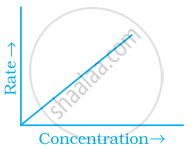 |
|
| (ii) | 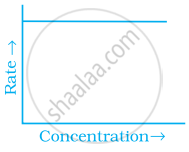 |
(a) 1st order |
| (iii) | 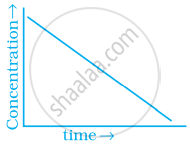 |
(b) Zero-order |
| (iv) | 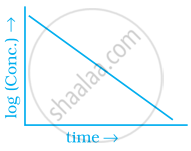 |
Assertion: Order and molecularity are same.
Reason: Order is determined experimentally and molecularity is the sum of the stoichiometric coefficient of rate determining elementary step.
Assertion: The enthalpy of reaction remains constant in the presence of a catalyst.
Reason: A catalyst participating in the reaction, forms different activated complex and lowers down the activation energy but the difference in energy of reactant and product remains the same.
Use Molecular Orbital theory to determine the bond order in each of species, [He2j+ and [He2]2+?
In the presence of a catalyst, the heat evolved or absorbed during the reaction.
For a reaction A + B → products, the rate law is given by: r = `K[A]^(1/2)`. What is the order of reaction?
For a reaction \[\ce{Cl2l(g) + 2No(g) -> 2NaCl(g)}\] the rate law is expressed as rate= K[Cl2] [No]2 what is the order of the reaction?
The number of molecules of the reactants taking part in a single step of the reaction is indicative of ______.
For the reaction, \[\ce{A +2B → AB2}\], the order w.r.t. reactant A is 2 and w.r.t. reactant B. What will be change in rate of reaction if the concentration of A is doubled and B is halved?
A drop of solution (volume 0.05 ml) contains 3.0 × 10⁻⁶ mole of H+. If the rate constant of disappearance of H+ is 1.0 × 10⁷ mole l-1s-1. It would take for H+ in drop to disappear in ______ × 10-9s.
A flask contains a mixture of compounds A and B. Both compounds decompose by first-order kinetics. The half-lives for A and B are 300 s and 180 s, respectively. If the concentrations of A and B are equal initially, the time required for the concentration of A to be four times that of B (in s) is ______. (Use ln 2 = 0.693)
Assertion (A): Order of reaction is applicable to elementary as well as complex reactions.
Reason (R): For a complex reaction, molecularity has no meaning.
Higher yield of NO in \[\ce{N2(g) + O2 <=> 2NO(g)}\] can be obtained at:
[ΔH of the reaction = +180.7 kJ mol−1]
- higher temperature
- lower temperature
- higher concentration of N2
- higher concentration of O2
Choose the correct answer from the options given below:
