Advertisements
Advertisements
प्रश्न
Fig. shows a 3 pin plug with the cover removed. The electric cable
connected to the plug contains 3 wires with colour coded insulation namely brown, blue and green.
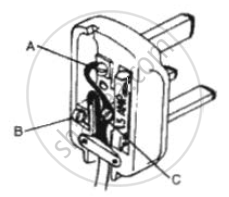
- Identify each of the colour coded wires by stating to which of the
terminals A, B or C in the diagram they should be connected. - Identify the terminal through which no current passes in normal
circumstances. - What is the purpose of the earthed wire connected to an electric
appliance like an electric heater? Describe how it works.
Advertisements
उत्तर
(a) Brown wire or live wire should be connected to terminal C.
Blue wire or neutral wire should be connected to terminal B.
Green wire or earth wire should be connected to terminal A.
(b) No, current passes through the earth terminal i.e. terminal A in normal circumstances.
(c) The metal case of an electrical appliance is earthed so that in any case of accidental contact of live wire with the metallic body of the appliance, the earth wire would provide a safe and easy path for the electric charges to flow down to the earth which acts as very large sink. Thus, user is thereby protected from any fatal electric shock.
संबंधित प्रश्न
Fill in the folloing blank with suitable words:
A current is a flow of ............... .For this to happen there must be a ............... circuit.
Which statement/statement is/are correct?
1. An ammeter is connected in series in a circuit and a voltmeter is connected in parallel.
2. An ammeter has a high resistance.
3. A voltmeter has a low resistance.
(a) 1, 2, 3
(b) 1, 2
(c) 2, 3
(d) 1
Consider the circuit given below:
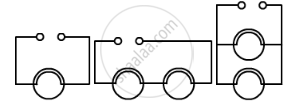
(a) In which circuit are the lamps dimmest?
(b) In which circuit or circuits are the lamps of equal brightness to the lamps in circuit (i)?
(c) Which circuit gives out the maximum light?
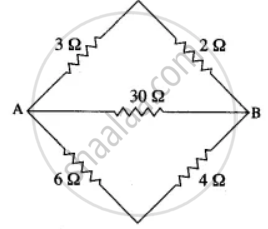
Calculate the equivalent resistance between A and B in the adjacent diagram.
If the potential differences between two parts of a thundercloud is 10s V,
what is the amount of energy given up during the passage of 20 coulombs?
(a)2x10⁻⁷J
(b)200J
(c)Sx106 j
(d)2x 10⁹J
(e)2x 10¹⁰ J
Electrical power P is given by the expression P = (Q × V) ÷ time
(a) What do the symbols Q and V represent?
(b) Express the power P in terms of current and resistance explaining the meanings of symbols used there in.
A geyser is rated 1500 W, 250 V. This geyser is connected to 250 V mains. Calculate:
- The current drawn,
- The energy consumed in 50 hours, and
- The cost of energy consumed at ₹ 4.20 per kWh.
A current of 1 A is drawn by a filament of an electric bulb. Number of electrons passing through a cross section of the filament in 16 seconds would be roughly
