Advertisements
Advertisements
प्रश्न
Explain the terms Dialysis
Advertisements
उत्तर
Dialysis - The process of removing a dissolved substance from a colloidal solution by the means of diffusion through a membrane is known as dialysis. This process is based on the principle that ions and small molecules can pass through animal membranes unlike colloidal particles.
संबंधित प्रश्न
What modification can you suggest in the Hardy-Schulze law?
Explain what is observed when a beam of light is passed through a colloidal sol.
Explain what is observed when an electrolyte NaCl is added to hydrated ferric oxide sol.
Explain the terms Coagulation
What happens when a freshly prepared precipitate of Fe(OH)3 is shaken with a small amount of FeCl3 solution?
What happens when persistent dialysis of a colloidal solution is carried out?
What happens when an emulsion is centrifuged?
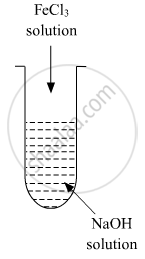
A colloidal sol is prepared by the given method in the figure. What is the charge on hydrated ferric oxide colloidal particles formed in the test tube? How is the sol represented?
Which of the following will show Tyndall effect?
How does it become possible to cause artificial rain by spraying silver iodide on the clouds?
Give reason for the following:
Lyophilic colloidal solutions are more stable than lyophobic colloidal solutions.
Gold number is associated with:-
What is electrophoresis?
Why a negatively charged sol is obtained when AgNO3 solution is added to KI solution?
6.84 g Al2(SO4)3 is needed to coagulate 2.5 L of As2S3 sol completely in 2.0 hrs. The coagulation value of Al2 (SO4)3 is ______.
Lyophilic sols are more stable than lyophobic sols because ______.
