Advertisements
Advertisements
प्रश्न
Why a negatively charged sol is obtained when AgNO3 solution is added to KI solution?
Advertisements
उत्तर
When AgNO3 solution is added to the aqueous solution of KI, a negatively charged sol of AgI is formed. It is due to the selective adsorption of \[\ce{I–}\] ion from the dispersion medium.
\[\ce{AgI + I^- -> [AgI]I^-}\]
APPEARS IN
संबंधित प्रश्न
Define the following terms: Associated colloids
Define the following term : Brownian movement
Explain the terms Coagulation
Explain the terms Dialysis
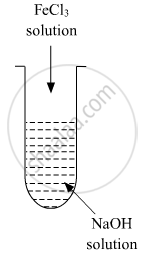
A colloidal sol is prepared by the given method in the figure. What is the charge on hydrated ferric oxide colloidal particles formed in the test tube? How is the sol represented?
Which of the following statements are correct?
(i) Mixing two oppositely charged sols neutralises their charges and stabilises the colloid.
(ii) Presence of equal and similar charges on colloidal particles provides stability to the colloids.
(iii) Any amount of dispersed liquid can be added to emulsion without destabilising it.
(iv) Brownian movement stabilises sols.
What causes brownian motion in colloidal dispersion?
Why does leather get hardened after tanning?
What is Gold number?
Define the following term:
Coagulation
