Advertisements
Advertisements
प्रश्न
What happens when a lyophilic sol is added to a lyophobic sol?
(i) Lyophobic sol is protected.
(ii) Lyophilic sol is protected.
(iii) Film of lyophilic sol is formed over lyophobic sol.
(iv) Film of lyophobic sol is formed over lyophilic sol.
Advertisements
उत्तर
(i) Lyophobic sol is protected.
(iii) Film of lyophilic sol is formed over lyophobic sol.
Explanation:
Lyophilic colloids have a unique property of protecting lyophobic colloids. When a lyophilic sol is added to the lyophobic sol, the lyophilic particles form a layer around lyophobic particles and thus protect the latter from electrolytes. Lyophilic colloids used for this purpose are called protective colloid.
APPEARS IN
संबंधित प्रश्न
Define the following term:
Zeta potential
Give reasons for the following observations:
Brownian movement provides stability to the colloidal solution.
Out of MgCl2 and AlCl3, which one is more effective in causing coagulation of negatively charged sol and why?
Define the following term : Brownian movement
Explain what is observed when an electric current is passed through a colloidal sol?
What happens when a freshly prepared precipitate of Fe(OH)3 is shaken with a small amount of FeCl3 solution?
What happens when an emulsion is centrifuged?
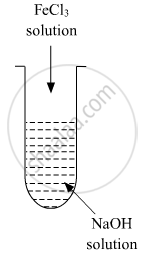
A colloidal sol is prepared by the given method in the figure. What is the charge on hydrated ferric oxide colloidal particles formed in the test tube? How is the sol represented?
The values of colligative properties of colloidal solution are of small order in comparison to those shown by true solutions of same concentration because of colloidal particles ______.
Which of the following statements are correct?
(i) Mixing two oppositely charged sols neutralises their charges and stabilises the colloid.
(ii) Presence of equal and similar charges on colloidal particles provides stability to the colloids.
(iii) Any amount of dispersed liquid can be added to emulsion without destabilising it.
(iv) Brownian movement stabilises sols.
Why do we add alum to purify water?
What causes brownian motion in colloidal dispersion?
Why does leather get hardened after tanning?
Give reason for the following:
Lyophilic colloidal solutions are more stable than lyophobic colloidal solutions.
What is Gold number?
Which of the following is used for removing change on colloidal solution?
The right option for the statement “Tyndall effect is exhibited by”, is:
Which of the following is a correct statement?
6.84 g Al2(SO4)3 is needed to coagulate 2.5 L of As2S3 sol completely in 2.0 hrs. The coagulation value of Al2 (SO4)3 is ______.
