Advertisements
Advertisements
प्रश्न
Explain the terms Coagulation
Advertisements
उत्तर
Coagulation: The process of settling down of colloidal particles i.e., conversion of a colloid into a precipitate is called coagulation.
संबंधित प्रश्न
What is the reason for the stability of colloidal sols?
Give reasons for the following observations: Leather gets hardened after tanning.
What modification can you suggest in the Hardy-Schulze law?
Explain what is observed when an electrolyte NaCl is added to hydrated ferric oxide sol.
Explain what is observed when an electric current is passed through a colloidal sol?
Explain the terms Dialysis
What happens when persistent dialysis of a colloidal solution is carried out?
What happens when an emulsion is centrifuged?
Answer the following question.
Why are medicines more effective in the colloidal state?
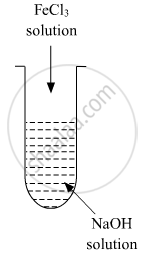
A colloidal sol is prepared by the given method in the figure. What is the charge on hydrated ferric oxide colloidal particles formed in the test tube? How is the solution represented?

A colloidal sol is prepared by the given method in the figure. What is the charge on hydrated ferric oxide colloidal particles formed in the test tube? How is the sol represented?
What causes brownian motion in colloidal dispersion?
Match the statement given in Column I with the phenomenon given in Column II.
| Column I | Column II |
| (i) Dispersion medium moves in an electric field | (a) Osmosis |
| (ii) Solvent molecules pass through semi permeable membrane towards solvent side |
(b) Electrophoresis |
| (iii) Movement of charged colloidal particles under the influence of applied electric potential towards oppositely charged electrodes |
(c) Electroosmosis |
| (iv) Solvent molecules pass through semi permeable membranes towards solution side |
(d) Reverse osmosis |
Assertion: An ordinary filter paper impregnated with collodion solution stops the flow of colloidal particles.
Reason: Pore size of the filter paper becomes more than the size of colloidal particle.
Tyndall effect is observed in
The important factor in the stabilization of a colloidal solution is ______
The right option for the statement “Tyndall effect is exhibited by”, is:
Define the following term:
Coagulation
