Advertisements
Advertisements
प्रश्न
State the Hardy-Schulze rule.
Advertisements
उत्तर
The Hardy-Schulze rule states that the greater the valency of the oppositely charged ion of the electrolyte being added, faster is coagulation. The greater the valency of the flocculating ion, the greater its power to coagulate.
संबंधित प्रश्न
Define the following term:
Zeta potential
Explain the terms Dialysis
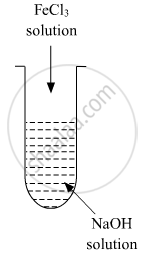
A colloidal sol is prepared by the given method in the figure. What is the charge on hydrated ferric oxide colloidal particles formed in the test tube? How is the sol represented?
The values of colligative properties of colloidal solution are of small order in comparison to those shown by true solutions of same concentration because of colloidal particles ______.
Which phenomenon occurs when an electric field is applied to a colloidal solution and electrophoresis is prevented?
(i) Reverse osmosis takes place.
(ii) Electroosmosis takes place.
(iii) Dispersion medium begins to move.
(iv) Dispersion medium becomes stationary.
What causes brownian motion in colloidal dispersion?
Assertion: Colloidal solutions do not show brownian motion.
Reason: Brownian motion is responsible for stability of sols.
Assertion: Coagulation power of Al3+ is more than Na+.
Reason: Greater the valency of the flocculating ion added, greater is its power to cause precipitation (Hardy Schulze rule).
Which of the following is used for removing change on colloidal solution?
Lyophilic sols are more stable than lyophobic sols because ______.
