Advertisements
Advertisements
प्रश्न
Evaluate the following limits:
`lim_(alpha -> 0) (sin(alpha^"n"))/(sin alpha)^"m"`
Advertisements
उत्तर
We know `lim_(x -> 0) (sin x)/x` = 1
`lim_(alpha -> 0) (sin(alpha^"n"))/(sin alpha)^"m" = lim_(alpha -> 0) (sin (alpha^"n"))/(1/alpha^"n" (alpha^"n")) xx (alpha^(1/"m") * alpha^"m")/(sin alpha)^"m"`
= `lim_(alpha -> 0) alpha^"n" * (sin(alpha^"n"))/alpha^"n" xx 1/alpha^"m" * 1/(((sinalpha)^"m")/(alpha^"m"))`
= `lim_(alpha -> 0) alpha^("n" - "m") *(sin(alpha^"n"))/alpha^"n" xx 1/((sinalpha)/alpha)^"m"`
= `(lim_(alpha -> 0) alpha^("n" - "m")) xx (lim_(alpha^"n" -> 0) (sin(alpha^"n"))/alpha^"n") xx 1/(lim_(alpha -> 0) ((sin alpha)/alpha)^"m")`
Case (i) m = n
`lim_(alpha -> 0) (sin(alpha^"n"))/(sin alpha)^"m" = (lim_(alpha -> 0) alpha^("m" - "m")) (lim_(alpha^"m" -> 0) (sin(alpha^"m"))/alpha^"m") xx 1/(lim_(alpha -> 0) ((sin alpha)/alpha)^"m")`
= `(lim_(alpha -> 0) alpha^0) xx 1 xx 1/1`
`lim_(alpha -> 0) (sin(alpha^"n"))/(sin alpha)^"m" = 1 xx 1 xx 1` = 1
Case (ii) m > n then n – m < 0
`lim_(alpha -> 0) (sin(alpha^"n"))/(sin alpha)^"m" = (lim_(alpha -> 0) alpha^("n" - "m")) (lim_(apha^"m" -> 0) (sin(alpha^"m"))/alpha^"m") xx 1/((lim_(alpha-> 0) ((sin alpha)/alpha)^"m"))`
= `lim_(alpha -> 0) 1/(alpha^("m" - "n")) xx 1 xx 1/1`
= `oo xx 1 xx 1 = oo`
Since `lim_(alpha -> 0) 1/(alpha^("m" - "n")) = lim_(alpha -> 0) (1/0)^("m" - "n") = oo`
Case (iii) m < n then n – m > 0
`lim_(alpha -> 0) (sin(alpha^"n"))/(sin alpha)^"m" = (lim_(alpha -> 0) alpha^("n" - "m")) (lim_(alpha^"m" -> 0) (sin(alpha^"m"))/(alpha^"m")) xx 1/(lim_(alpha-> 0) ((sin alpha)/alpha)^"m"`
= `(0)^("n" - "m") xx 1 xx 1`
= 0
∴ `lim_(alpha -> 0) (sin(alpha^"n"))/(sin alpha)^"m" = {{:(1, "if", "m" = "n"),(oo, "if", "m" > "n"),(0, "if", m < n):}`
APPEARS IN
संबंधित प्रश्न
Evaluate the following limit :
`lim_(z -> "a")[((z + 2)^(3/2) - ("a" + 2)^(3/2))/(z - "a")]`
Evaluate the following :
Given that 7x ≤ f(x) ≤ 3x2 – 6 for all x. Determine the value of `lim_(x -> 3) "f"(x)`
Evaluate the following :
`lim_(x -> 0) [(sqrt(1 - cosx))/x]`
In problems 1 – 6, using the table estimate the value of the limit
`lim_(x -> 2) (x - 2)/(x^2 - 4)`
| x | 1.9 | 1.99 | 1.999 | 2.001 | 2.01 | 2.1 |
| f(x) | 0.25641 | 0.25062 | 0.250062 | 0.24993 | 0.24937 | 0.24390 |
In exercise problems 7 – 15, use the graph to find the limits (if it exists). If the limit does not exist, explain why?
`lim_(x -> 2) f(x)` where `f(x) = {{:(4 - x",", x ≠ 2),(0",", x = 2):}`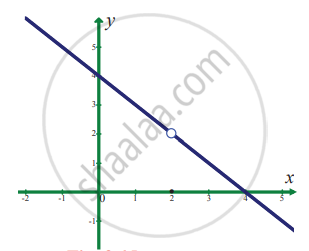
In exercise problems 7 – 15, use the graph to find the limits (if it exists). If the limit does not exist, explain why?
`lim_(x -> 3) 1/(x - 3)`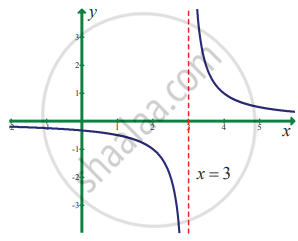
Evaluate the following limits:
`lim_(x -> 0) (sqrt(x^2 + 1) - 1)/(sqrt(x^2 + 16) - 4)`
Evaluate the following limits:
`lim_(x -> "a") (sqrt(x - "b") - sqrt("a" - "b"))/(x^2 - "a"^2) ("a" > "b")`
Evaluate the following limits:
`lim_(x -> oo) ((2x^2 + 3)/(2x^2 + 5))^(8x^2 + 3)`
Evaluate the following limits:
`lim_(x -> oo) (1 + 3/x)^(x + 2)`
Evaluate the following limits:
`lim_(x -> 0) (tan 2x)/(sin 5x)`
Evaluate the following limits:
`lim_(x -> oo) ((x^2 - 2x + 1)/(x^2 -4x + 2))^x`
Evaluate the following limits:
`lim_(x -> ) (sinx(1 - cosx))/x^3`
Evaluate the following limits:
`lim_(x -> 0) (tan x - sin x)/x^3`
Choose the correct alternative:
`lim_(x - oo) sqrt(x^2 - 1)/(2x + 1)` =
Choose the correct alternative:
`lim_(x -> oo) (1/"n"^2 + 2/"n"^2 + 3/"n"^2 + ... + "n"/"n"^2)` is
Choose the correct alternative:
`lim_(x -> 0) ("e"^(sin x) - 1)/x` =
`lim_(x→0^+)(int_0^(x^2)(sinsqrt("t"))"dt")/x^3` is equal to ______.
The value of `lim_(x→0)(sin(ℓn e^x))^2/((e^(tan^2x) - 1))` is ______.
