Advertisements
Advertisements
प्रश्न
Draw a schematic diagram of a circuit consisting of a battery of three cells of 2 V each, a 5 Ω resistor, an 8 Ω resistor, and a 12 Ω resistor, and a plug key, all connected in series.
Advertisements
उत्तर
Three cells of potential 2 V, each connected in series; therefore, the potential difference of the battery will be 2 V + 2 V + 2 V = 6V. The following circuit diagram shows three resistors of resistances 5 Ω, 8 Ω and 12 Ω, respectively, connected in series, and a battery of potential 6 V and a plug key, which is closed, means the current is flowing in the circuit.

APPEARS IN
संबंधित प्रश्न
The following figure shows the symbols for components used in the accompanying electrical circuit. Place them at proper places and complete the circuit.
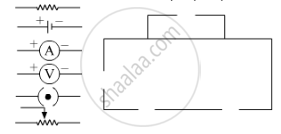
Which law can you prove with the help of above circuit?
The accompanying figure shows some electrical appliances connected in a circuit in a house. Answer the following questions.

- By which method are the appliances connected?
- What must be the potential difference across individual appliances?
- Will the current passing through each appliance be the same? Justify your answer.
- Why are the domestic appliances connected in this way?
- If the T.V. stops working, will the other appliances also stop working? Explain your answer.
Answer the following question.
With the help of a suitable circuit diagram prove that the reciprocal of the equivalent resistance of a group of resistances joined in parallel is equal to the sum of the reciprocals of the individual resistances.
What do you understand by the open electric circuit?
Explain the following:
Open circuit
The switch is used to close or open an electric circuit.
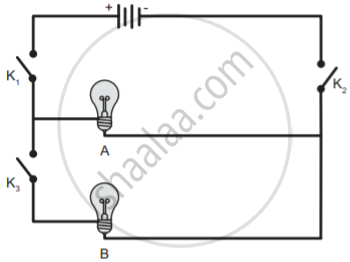
In the given circuit diagram, which of the given switch(s) should be closed. So that only bulb A glows.
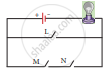
In the circuit shown, which switches (L,M or N) must be closed to light up the bulb?
Higher Order Question
A student made a circuit by using an electric cell, a switch, a torch bulb (fitted in the bulb holder), and copper connecting wires. When he turned on the switch, the torch bulb did not glow at all. The student checked the circuit and found that all the wire connections were tight.
- What could be the possible reason for the torch bulb not glowing even when the circuit appears to be complete?
What is electric circuit?
The wiring in a house consists of ______ circuits.
A device that is used to break an electric circuit is called ______.
In the following circuits (Figure), heat produced in the resistor or combination of resistors connected to a 12 V battery will be
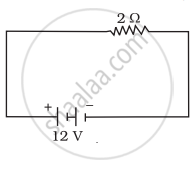 |
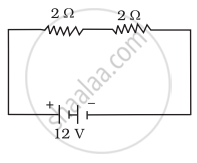 |
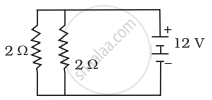 |
| (i) | (ii) | (iii) |
In an electrical circuit two resistors of 2 Ω and 4 Ω respectively are connected in series to a 6 V battery. The heat dissipated by the 4 Ω resistor in 5 s will be
When an electric current flows through a copper wire AB as shown in the following figure, the wire

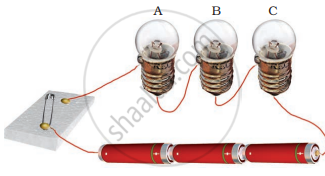
Three bulbs A, B, C are connected in a circuit as shown in the following figure. When the switch is ‘ON’
In an electric circuit a fuse is a ______ ______ to prevent possible fire.
The ______ is a species of fish that can give electric shocks of up to six hundred fifty watts of electricity.
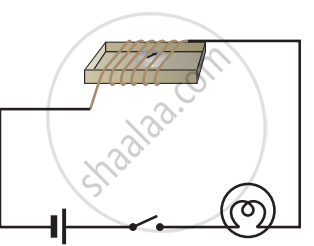
Set up the circuit shown in Figure again. Move the key to ‘ON’ position and watch carefully in which direction the compass needle gets deflected. Switch ‘OFF’ the current. Now keeping rest of the circuit intact, reverse the connections at the terminal of the cell. Again switch ‘on’ the current. Note the direction in which the needle gets deflected. Think of an explanation.