Advertisements
Advertisements
प्रश्न
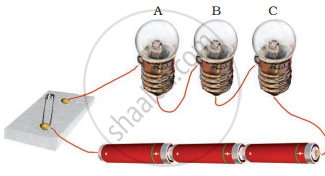
Three bulbs A, B, C are connected in a circuit as shown in the following figure. When the switch is ‘ON’
विकल्प
bulb C will glow first.
bulb B and C will glow simultaneously and bulbs A will glow after some time.
all the bulbs A, B and C will glow at the same time.
the bulbs will glow in the order A, B and C.
Advertisements
उत्तर
all the bulbs A, B and C will glow at the same time.
Explanation:
If the three bulbs A, B and C are connected in parallel in the circuit and the switch is turned on, then all of them will receive the same voltage simultaneously. This results in all the bulbs glowing at the same time.
If they are connected in series, they would all light up in the same order as the current flows, but typically, in a standard setup, parallel connection is the most common for all bulbs to glow at the same time when the switch is turned on.
APPEARS IN
संबंधित प्रश्न
Draw circuit symbols for variable resistance
Draw circuit symbols for
a cell
Draw circuit symbols for
an open switch
Name the instrument used to control current in an electric circuit.
What is open circuit?
Tabulate the different components of an electric circuit and their respective symbols.
______ is a kind of fish which is able to produce an electric current.
In an electrical circuit two resistors of 2 Ω and 4 Ω respectively are connected in series to a 6 V battery. The heat dissipated by the 4 Ω resistor in 5 s will be
Overloading of electric circuits can lead to short-circuiting.
A complete circuit is left on for several minutes, causing the connecting copper wire to become hot. As the temperature of the wire increases, the electrical resistance of the wire
