Advertisements
Advertisements
प्रश्न
Redraw the circuit of question 1, putting in an ammeter to measure the current through the resistors and a voltmeter to measure the potential difference across the 12 Ω resistors. What would be the readings in the ammeter and the voltmeter?
Advertisements
उत्तर
An ammeter should be connected in the circuit in series with the resistors. To measure the potential difference across the resistor it should be connected in parallel, as shown in the following figure.

The resistances are connected in series.
Ohm’s law can be used to obtain the readings of ammeter and voltmeter.
According to Ohm’s law,
V = IR,
Where,
Potential difference, V = 6 V
Current flowing through the circuit/resistors = I
Resistance of the circuit, R = 5 + 8 + 12 = 25Ω
I = `V/R`
= `6/25`
= 0.24 A
Potential difference across 12 Ω resistor = V1
Current flowing through the 12 Ω resistor, I = 0.24 A
Therefore, using Ohm’s law, we obtain
V1 = IR
= 0.24 × 12
= 2.88 V
Therefore, the reading of the ammeter will be 0.24 A.
The reading of the voltmeter will be 2.88 V.
संबंधित प्रश्न
Draw circuit symbols for
a battery of three cells
In an electric circuit, a battery and a bulb have been connected and the battery consists of two cells of equal potential difference. If the bulb is not glowing, then which tests will you perform in order to find out the reason for the bulb not glowing?
Distinguish between a closed circuit and an open circuit, with the use of suitable labelled diagrams.
Explain the following:
Open circuit
The unit of electrical power is _______.
Nowadays MCBs are used in homes, for stop the current in the circuit which suddenly increases.
______ is the device used to close or open an electric circuit.
In which of the following circuits are the bulb connected in series?
Which of the following a simple circuit must-have?
_____ has a thin metallic filament that melts and breaks the connection when the circuit is overheated.
In a simple circuit, why does the bulb glow when you close the switch?
Instead of metal wires, a jute string can be used to make a circuit.
______ is a kind of fish which is able to produce an electric current.
Observe the circuit given:
1. Would any of the bulbs glow when the switch is in the ‘OFF’ position?
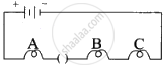
2. What will be the order in which the bulbs A, B, and C will glow when the switch is moved to the ‘ON’ position?
Paheli is running short of connecting wires. To complete an electric circuit, she may use a ______.
Paheli connected two bulbs to a cell as shown in the following figure.
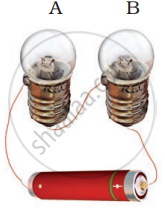
She found that filament of bulb B is broken. Will the bulb A glow in this circuit? Give reason.
Overloading of electric circuits can lead to short-circuiting.
Name the device which is used to measure the strength of the electric current in an electric circuit.
An electric motor rated 1100 W is connected to 220 V mains. Find:
- The current drawn from the mains,
- Electric energy consumed if the motor is used for 5 hours daily for 6 days.
- Total cost of energy consumed if the rate of one unit is 5.
Set up the circuit shown in Figure again. Move the key to ‘ON’ position and watch carefully in which direction the compass needle gets deflected. Switch ‘OFF’ the current. Now keeping rest of the circuit intact, reverse the connections at the terminal of the cell. Again switch ‘on’ the current. Note the direction in which the needle gets deflected. Think of an explanation.