Advertisements
Advertisements
प्रश्न
Diagonals of a parallelogram intersect each other at point O. If AO = 5, BO = 12 and AB = 13 then show that `square`ABCD is a rhombus.
Advertisements
उत्तर
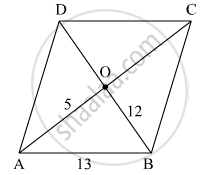
Given: AO = 5, BO = 12 and AB = 13
To Prove: `square`ABCD is a rhombus.
Proof:
AO2 + BO2
= 52 + 122
= 25 + 144
= 169 ...(i)
∴ AB2 = 132 = 169 ...(ii)
∴ AB2 = AO2 + BO2 ...[From (i) and (ii)]
∴ ∆AOB is a right-angled triangle. ...[Converse of Pythagoras theorem]
∴ ∠AOB = 90°
∴ seg AC ⊥ seg BD ...(iii) [A-O-C]
∴ In parallelogram ABCD,
∴ seg AC ⊥ seg BD ...[From (iii)]
∴ `square`ABCD is a rhombus. ...[A parallelogram is a rhombus perpendicular to each other]
APPEARS IN
संबंधित प्रश्न
The following figure is parallelogram. Find the degree values of the unknown x, y, z.
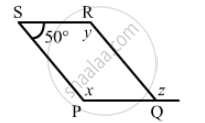
The following figure is parallelogram. Find the degree values of the unknown x, y, z.
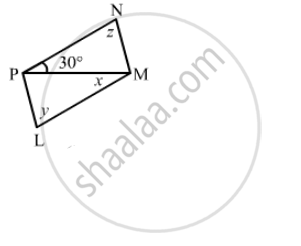
Can the following figure be parallelogram. Justify your answer.
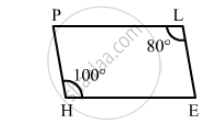
In the following figure GUNS and RUNS are parallelogram. Find x and y.
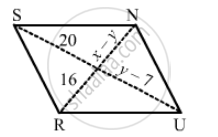
If an angle of a parallelogram is two-third of its adjacent angle, find the angles of the parallelogram.
Which of the following statement is true for a rhombus?
It has two pairs of parallel sides.
Which of the following statement is true for a rhombus?
Two of its angles are at right angles
Which of the following statement is true for a rhombus?
It is a quadrilateral.
The diagonals of a quadrilateral are perpendicular to each other. Is such a quadrilateral always a rhombus? If your answer is 'No', draw a figure to justify your answer.
Identify all the quadrilateral that have Four sides of equal length
Diagonals PR and QS of a rhombus PQRS are 20 cm and 48 cm respectively. Find the length of side PQ.
Draw a rhombus KLMN such that its side is 4 cm and m∠K = 75°.
Measure of one angle of a rhombus is 50°, find the measures of remaining three angles.
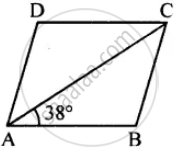
ABCD is a rhombus. If ∠BAC = 38°, find :
(i) ∠ACB
(ii) ∠DAC
(iii) ∠ADC.
The lengths of the diagonals of a Rhombus are 12 cm and 16 cm. Find the side of the rhombus
If the adjacent sides of a parallelogram are equal then parallelogram is a ______.
In the figure, BEST is a rhombus, Then the value of y – x is ______.
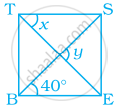
If a diagonal of a quadrilateral bisects both the angles, then it is a ______.
All rhombuses are squares.
