Advertisements
Advertisements
प्रश्न
Derive Laplace’s law for spherical membrane of bubble due to surface tension.
Derive Laplace’s law for a spherical membrane.
Advertisements
उत्तर १
Consider a spherical liquid drop and let the outside pressure be Po and inside pressure be Pi, such that the excess pressure is Pi − Po
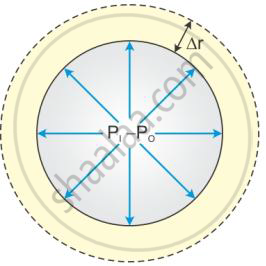
Let the radius of the drop increase from r to Δr, where Δr is very small, so that the pressure inside the drop remains almost constant.
Initial surface area (A1) = 4Πr2
Final surface area (A2) = 4Π(r + Δr)2
= 4π(r2 + 2rΔr + Δr2)
= 4Πr2 + 8ΠrΔr + 4ΠΔr2
As Δr is very small, Δr2 is neglected (i.e. 4πΔr2≅0)
Increase in surface area (dA) =A2 - A1= 4Πr2 + 8ΠrΔr - 4Πr2
Increase in surface area (dA) =8ΠΔr
Work done to increase the surface area by 8ΠrΔr is extra energy.
∴ dW = TdA
∴ dW = T*8πrΔr .......(Equ.1)
This work done is equal to the product of the force and the distance Δr.
dF=(P1 - P0)4πr2
The increase in the radius of the bubble is Δr.
dW = dFΔr = (P1 - P0)4Πr2*Δr ..........(Equ.2)
Comparing Equations 1 and 2, we get
(P1 - P0)4πr2*Δr = T*8πrΔr
∴`(P_1 - P_0) = (2T)/R`
This is called Laplace’s law of spherical membrane.
उत्तर २
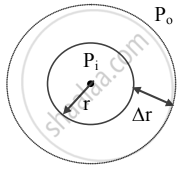
- The free surface of drops or bubbles is spherical in shape.
Let,
Pi = inside pressure of a drop or air bubble
Po = outside pressure of the bubble
r = radius of drop or bubble. - As drop is spherical, Pi > Po
∴ excess pressure inside drop = Pi − Po - Let the radius of drop increase from r to r + ∆r so that inside pressure remains constant.
- Initial area of drop A1 = 4πr2 ,
Final surface area of drop A2 = 4π (r + ∆r)2
Increase in surface area,
∆A = A2 − A1 = 4π[(r + ∆r)2 − r2]
= 4π[r2 + 2r∆r + ∆r2 − r2]
= 8πr∆r + 4π∆r2 - As ∆r is very small, the term containing ∆r2 can be neglected.
∴ dA = 8πr∆r - Work is done by a force of surface tension,
dW = TdA = (8πr∆r)T ….(1)
This work done is also equal to the product of the force F which causes an increase in the area of the bubble and the displacement Δr which is the increase in the radius of the bubble.
∴ dW = FΔr
The excess force is given by,
(Excess pressure) × (Surface area)
∴ F = (Pi – Po) × 4πr2
∴ dF = (Pi – Po)A
dW = F∆r = (Pi − Po) A∆r
From equation (1),
(Pi − Po) A∆r = (8πr∆r) T
∴ Pi − Po = `(8pirDeltarT)/(4pir^2Deltar)` ........(∵ A = 4πr2)
∴ Pi − Po = `(2T)/r` ….(2)
Equation (2) represents Laplace’s law of spherical membrane.
APPEARS IN
संबंधित प्रश्न
A raindrop of diameter 4 mm is about to fall on the ground. Calculate the pressure inside the raindrop. [Surface tension of water T = 0.072 N/m, atmospheric pressure = 1.013 x 10⁵ N/m2 ]
Define the angle of contact.
Explain why Surface tension of a liquid is independent of the area of the surface
Fill in the blanks using the word(s) from the list appended with each statement
Surface tension of liquids generally . . . with temperatures (increases / decreases)
A U-shaped wire is dipped in a soap solution and removed. The thin soap film formed between the wire and the light slider supports a weight of 1.5 × 10⁻² N (which includes the small weight of the slider). The length of the slider is 30 cm. What is the surface tension of the film?
Two narrow bores of diameters 3.0 mm and 6.0 mm are joined together to form a U-tube open at both ends. If the U-tube contains water, what is the difference in its levels in the two limbs of the tube? Surface tension of water at the temperature of the experiment is 7.3 × 10⁻² N m–1. Take the angle of contact to be zero and density of water to be 1.0 × 10³ kg m–3 (g = 9.8 m s–2)
A body weighs 4.0 kg-wt on the surface of the Earth. What will be its weight on the surface of a plant whose mass is `1/8` th of the mass of the Earth and radius half `(1/2)` of that of the Earth?
A big drop of radius R is formed from 1000 droplets of water. The radius of a droplet will be _______
A) 10 R
B) R/10
C) R/100
D) R/1000
Calculate the work done in increasing the radius of a soap bubble in air from 1 cm to 2 cm. The surface tension of soap solution is 30 dyne/cm. (Π = 3.142).
When a sparingly soluble substance like alcohol is dissolved in water, surface tension of water
The free surface of a liquid resting in an inertial frame is horizontal. Does the normal to the free surface pass through the centre of the earth? Think separately if the liquid is (a) at the equator (b) at a pole (c) somewhere else.
The contact angle between pure water and pure silver is 90°. If a capillary tube made of silver is dipped at one end in pure water, will the water rise in the capillary?
When a glass capillary tube is dipped at one end in water, water rises in the tube. The gravitational potential energy is thus increased. Is it a violation of conservation of energy?
Frictional force between solids operates even when they do not move with respect to each other. Do we have viscous force acting between two layers even if there is no relative motion?
Water near the bed of a deep river is quiet while that near the surface flows. Give reasons.
When water droplets merge to form a bigger drop
If more air is pushed in a soap bubble, the pressure in it
A 20 cm long capillary tube is dipped in water. The water rises up to 8 cm. If the entire arrangement is put in a freely falling elevator, the length of water column in the capillary tube will be
The properties of a surface are different from those of the bulk liquid because the surface molecules
(a) are smaller than other molecules
(b) acquire charge due to collision from air molecules
(c) find different type of molecules in their range of influence
(d) feel a net force in one direction.
The rise of a liquid in a capillary tube depends on
(a) the material
(b) the length
(c) the outer radius
(d) the inner radius of the tube
The contact angle between a solid and a liquid is a property of
(a) the material of the solid
(b) the material of the liquid
(c) the shape of the solid
(d) the mass of the solid
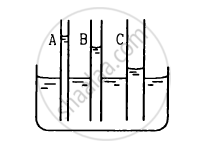
The capillaries shown in figure have inner radii 0.5 mm, 1.0 mm and 1.5 mm respectively. The liquid in the beaker is water. Find the heights of water level in the capillaries. The surface tension of water is 7.5 × 10⁻² N m−1.
Find the surface energy of water kept in a cylindrical vessel of radius 6.0 cm. Surface tension of water = 0.075 J m−2.
Two large glass plates are placed vertically and parallel to each other inside a tank of water with separation between the plates equal to 1 mm. Find the rise of water in the space between the plates. Surface tension of water = 0.075 Nm−1.
Consider an ice cube of edge 1.0 cm kept in a gravity-free hall. Find the surface area of the water when the ice melts. Neglect the difference in densities of ice and water.
Find the force exerted by the water on a 2 m2 plane surface of a large stone placed at the bottom of a sea 500 m deep. Does the force depend on the orientation of the surface?
A metal piece of mass 160 g lies in equilibrium inside a glass of water. The piece touches the bottom of the glass at a small number of points. If the density of the metal is 8000 kg/m3, find the normal force exerted by the bottom of the glass on the metal piece.
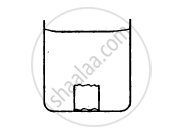
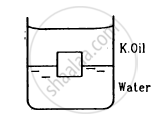
A cube of ice floats partly in water and partly in K.oil (in the following figure). Find the ratio of the volume of ice immersed in water to that in K.oil. Specific gravity of K.oil is 0.8 and that of ice is 0.9.
A cubical box is to be constructed with iron sheets 1 mm in thickness. What can be the minimum value of the external edge so that the cube does not sink in water? Density of iron = 8000 kg/m3 and density of water = 1000 kg/m3.
Solve the previous problem if the lead piece is fastened on the top surface of the block and the block is to float with its upper surface just dipping into water.
How much amount of work is done in forming a soap bubble of radius r?
Explain the capillary action.
Define surface tension.
A u-tube is made up of capillaries of bore 1 mm and 2 mm respectively. The tube is held vertically and partially filled with a liquid of surface tension 49 dyne/cm and zero angles of contact. Calculate the density of the liquid, if the difference in the levels of the meniscus is 1.25 cm. take g = 980 cm/s2
How does the friction arise between the surfaces of two bodies in relative motion?
How does surface tension help a plant?
Define the surface tension of a liquid.
Define the angle of contact for a given pair of solid and liquid.
Obtain an expression for the excess of pressure inside a
- liquid drop
- liquid bubble
- air bubble
A capillary of diameter d mm is dipped in water such that the water rises to a height of 30 mm. If the radius of the capillary is made `(2/3)` of its previous value, then compute the height up to which water will rise in the new capillary?
A spherical soap bubble A of radius 2 cm is formed inside another bubble B of radius 4 cm. Show that the radius of a single soap bubble which maintains the same pressure difference as inside the smaller and outside the larger soap bubble is lesser than the radius of both soap bubbles A and B.
A square frame of each side L is dipped in a soap solution and taken out. The force acting on the film formed is _____.
(T = surface tension of soap solution).
If the surface tension of a soap solution is 3 × 10⁻² N/m then the work done in forming a soap film of 20 cm × 5 cm will be ______.
A water drop of radius R' splits into 'n' smaller drops, each of radius 'r'. The work done in the process is ______.
T = surface tension of water
Soap solution is used for cleaning dirty clothes because ______.
Two narrow bores of diameter 5.0 mm and 8.0 mm are joined together to form a U-shaped tube open at both ends. If this U-tube contains water, what is the difference in the level of the two limbs, of the tube?
[Take surface tension of water T = 7.3 × 10⁻² Nm-1, angle of contact = 0, g = 10 ms-2 and density of water = 1.0 × 10³ kgm-3]
A liquid flows out drop by drop from a vessel through a vertical tube with an internal diameter of 2 mm, then the total number of drops that flows out during 10 grams of the liquid flow out ______. [Assume that the diameter of the neck of a drop at the moment it breaks away is equal to the internal diameter of tube and surface tension is 0.02 N/m].
When an air bubble of radius r rises from the bottom to the surface of a lake, its radius becomes `(5r)/4`. Taking the atmospheric pressure to be equal to the 10 m height of the water column, the depth of the lake would approximately be ______.
(ignore the surface tension and the effect of temperature)
The excess pressure inside a liquid drop is 500 Nm-2. If the radius of the drop is 2 mm, the surface tension of the liquid is x × 10-3 Nm-1. The value of x is ______.
The surface tension of a soap solution is T. The work done in blowing a soap bubble of diameter d to that of a diameter 2d is ______.
Work done to blow a bubble of volume V is W. The work done in blowing a bubble of volume 2V will be ______.
A spherical liquid drop of radius R is divided into eight equal droplets. If surface tension is T, then the work done in this process will be ______.
Calculate (i) the pressure due to the weight of the water at a depth of 2.5 m and (ii) the depth below the surface of water at which the pressure due to the weight of the water equals 1.0 atm.
A drop of water of radius 8 mm breaks into number of droplets each of radius 1 mm. How many droplets will be formed?
