Advertisements
Advertisements
प्रश्न
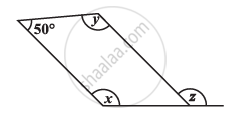
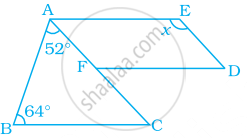
Consider the given parallelogram. Find the values of the unknowns x, y, z.
Advertisements
उत्तर
50° + y = 180° (Adjacent angles are supplementary)
y = 130°
x = y = 130° (Opposite angles are equal)
z = x = 130º (Corresponding angles)
संबंधित प्रश्न
Can a quadrilateral ABCD be a parallelogram if AB = DC = 8 cm, AD = 4 cm and BC = 4.4 cm?
Can a quadrilateral ABCD be a parallelogram if ∠A = 70° and ∠C = 65°?
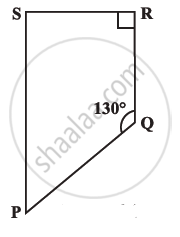
Find the measure of ∠P and ∠S, if `bar(SP) || bar(RQ)` in the following figure. (If you find m∠R, is there more than one method to find m∠P?).
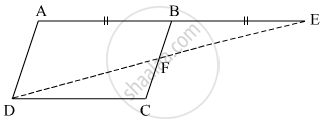
In the given figure, `square`ABCD is a parallelogram. Point E is on the ray AB such that BE = AB then prove that line ED bisects seg BC at point F.
Construct ☐ BARC such that l(BA) = l(BC) = 4.2 cm, l(AC) = 6.0 cm, l(AR) = l(CR) = 5.6 cm
In the given figure, AB || EC, AB = AC and AE bisects ∠DAC. Prove that:
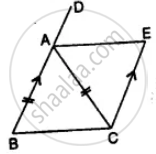
- ∠EAC = ∠ACB
- ABCE is a parallelogram.
The adjacent sides of a parallelogram are 5 cm and 9 cm. Its perimeter is ______.
In the following figure, FD || BC || AE and AC || ED. Find the value of x.
Construct a parallelogram ABCD in which AB = 4 cm, BC = 5 cm and ∠B = 60°.
Construct a parallelogram HOME with HO = 6 cm, HE = 4 cm and OE = 3 cm.
