Advertisements
Advertisements
प्रश्न
Consider an economy described by the following functions:- C = 20 + 0.80Y, I = 30, G = 50, TR = 100 (a) Find the equilibrium level of income and the autonomous expenditure multiplier in the model. (b) If government expenditure increases by 30, what is the impact on equilibrium income? (c) If a lump-sum tax of 30 is added to pay for the increase in government purchases, how will equilibrium income change?
Advertisements
उत्तर
(a) C = 20 + 0.80 Y `[barC=20]`
I = 30
c = 0.80
G = 50
T = 100
Equilibrium level of income
`Y=1/(1-c)[barC+cT+I+G]`
`=1/(1-0.80)[20+0.80xx100+30+50]`
`=1/0.20xx180=180/20xx100=900`
Expenditure multiplier `=1/(1-c)`
`=1/(1-0.80)=1/0.20=100/220=5`
(b) Increase in government expenditure
ΔG = 30
New equilibrium expenditure
`=1/(1-c)[barC+cT+I+G+DeltaG]`
`=1/(1-0.80)[20+0.80xx100+30+50+30]`
`=1/(1-0.80)[20+80+30+50+30]`
`=1/0.20xx210`
`=210/20xx100=1050`
Equilibrium level of income increases by 150 (1050 − 900)
(c) Tax multiplier `=(-c)/(1-c)`
`(DeltaY)/(DeltaT)=(-c)/(1-c)`
So, `DeltaY=(-c)/(1-c)xxDeltaT`
`=(-0.80)/(1-0.80)xx30`
`=(-0.80)/0.20xx30=-120`
New Equilibrium level of income = Y + ΔY
= 900 + (−120)
= Rs 780
APPEARS IN
संबंधित प्रश्न
Distinguish between revenue deficit and fiscal deficit.
Define revenue
Give the relationship between the revenue deficit and the fiscal deficit.
Suppose that for a particular economy, investment is equal to 200, government purchases are 150, net taxes (that is lump-sum taxes minus transfers) is 100 and consumption is given by C = 100 + 0.75Y (a) What is the level of equilibrium income? (b) Calculate the value of the government expenditure multiplier and the tax multiplier. (c) If government expenditure increases by 200, find the change in equilibrium income.
We suppose that C = 70 + 0.70Y D, I = 90, G = 100, T = 0.10Y (a) Find the equilibrium income. (b) What are tax revenues at equilibrium Income? Does the government have a balanced budget?
Explain why the tax multiplier is smaller in absolute value than the government expenditure multiplier.
Does public debt impose a burden? Explain.
Are fiscal deficits inflationary?
Answer the following question.
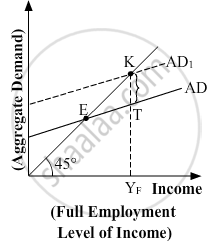
In the given figure, what does the gap 'KT' represent? State any two fiscal measures to correct the situation.
The primary deficit in a government budget is ______.
Which of the following statements is true?
Primary deficit is borrowing requirements of government for making:
Fiscal Deficit equals:
Fiscal deficit equals:
The Fiscal Deficit measures:
The Revenue Deficit is always a part (sub-component) of which deficit?
The Primary Deficit shows the borrowing requirement of the government:
Which of the following formulas correctly defines the Primary Deficit?
